 ToonCast
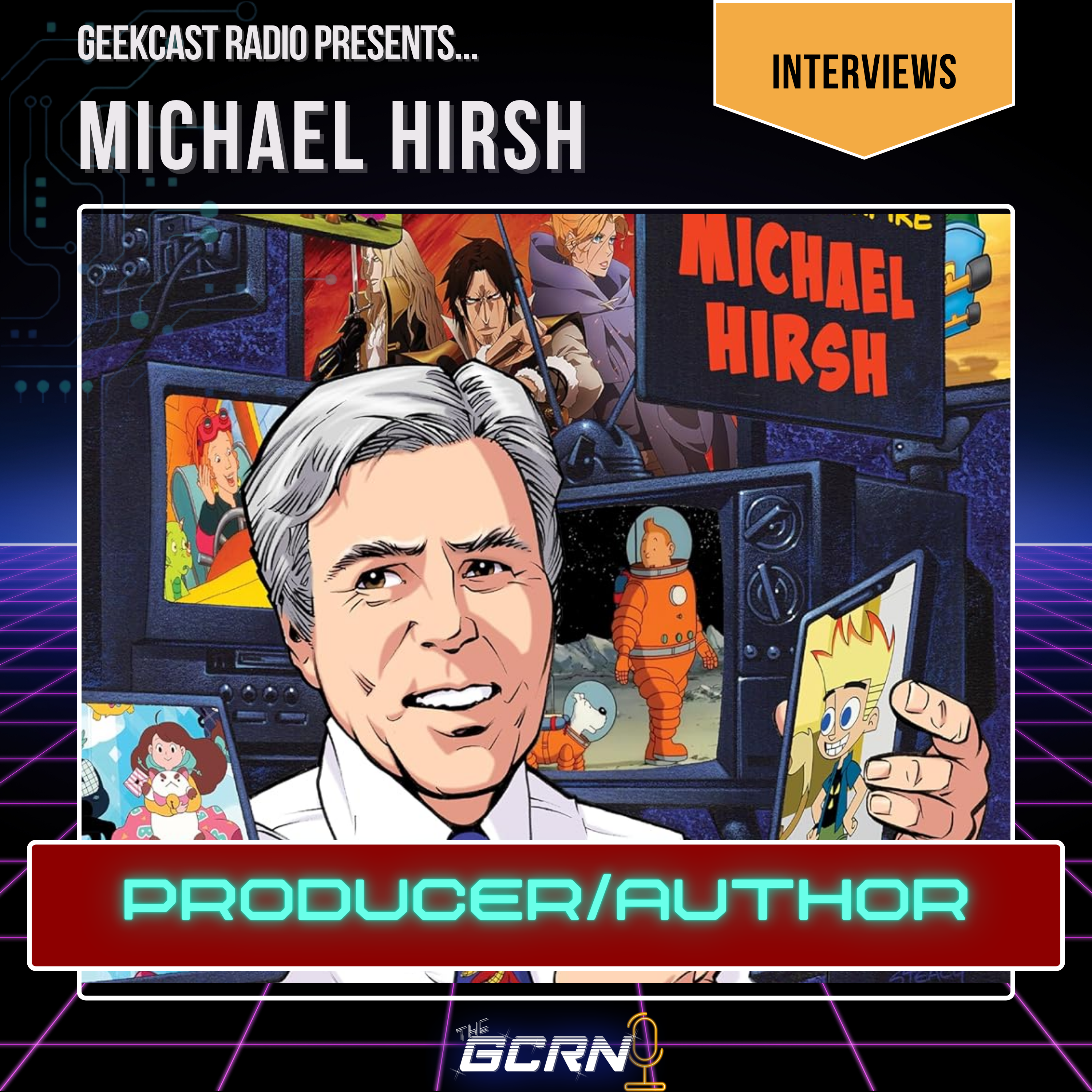
Interview with Michael Hirsh on Building Nelvana, Star Wars, and Animation’s Evolution
Part of a Collection
About this Episode
Hi, I'm Michael Hirsch. I've had a great career
in animation, making shows like the first Star
Wars cartoons, the Beetlejuice cartoon, Max and
Ruby, and many, many, many more. And you're listening
to me now on Geekcast Radio. You are listening
to another Geekcast Radio Presents interview.
I am one of your hosts, Steve June. Mike with
me, as always, is Steve Megatron. Hello, sir.
Hello. Today, tonight, whenever you find people
listening to this, we are going to be talking
with award -winning television producer, entrepreneur,
and author Michael Hirsch. From A Cosmic Christmas
to The Devil and Daniel Mouse, The Care Bears,
Star Wars, Droids and Ewoks. to Babar, the movie
and more, the Hardy Boys and Nancy Drew, which
I have a story about later, and Johnny Test,
along with Beetlejuice, Beetlejuice, Beetlejuice.
Uh -oh, I think I just summoned the demon. Plus
so much more, Michael has led an interesting
life and had an amazing career. Hi, Michael,
how are you? I'm doing great. Really happy to
be here talking to you and your audience tonight.
Absolutely, absolutely. All right, so we have
a lot of questions. We have both read your book,
Animation Nation. It is an excellent book. We
don't want to spoil it for anybody, but some
of the questions might be spoilers. Let's see.
All right, Steve, kick it off. So one of the
things that when I first was reading it through
was the, of course, Lucasfilm moment. Can you
describe a pivotal moment receiving the call
from Lucasfilm? Like, how did you maintain composure
and, you know, project the confidence, even though
Novana was a small company at the time? So the
call came out of the blue. Lucasfilm was working
on the two hour holiday special and George Lucas
had maintained control of the 10 minute cartoon
that he wanted in the special. And he was looking
for an animation company. And George wasn't particularly
a fan of doing things in L .A. He was Marin County,
San Francisco based himself and wanted to work
with people generally outside of L .A. But I
didn't know that at the time. What I did know
was that the call came from out of the blue.
We were busy making our second animated special,
The Devil and Daniel Mouse. And the person on
the other line. uh asked me if we were the company
that had produced a cosmic christmas and a cosmic
christmas was a holiday special that was our
first fully animated show was a you know half
television half hour show and uh lucas had seen
it even though it was a syndicated show not a
network show and so not easy to find not that
well promoted and uh he wanted to meet and talk
about whether we could do this cartoon for him
the 10 -minute cartoon which became The faithful
Wookiee. And so I flew down to L .A. No, I flew
down to San Francisco and rented a car, drove
to Marin County, followed the instructions I'd
been given. I landed in a shopping center in
San Rafael. And I was told that there would be
a telephone booth in the corner because this
is the era before mobile phones, even before
the brick phones. And so I go to the phone booth
and I call the number I was given. Somebody in
a nondescript building in the middle of the parking
lot waved to me and said, come on over. So I
walked over to the building, which had no number
on it and no branding. And I was told to shut
my eyes because I was going to walk through a
shot they were shooting of the Millennium Falcon.
For the Empire Strikes Back, which was still
in production. That's so awesome. So what were
some of the most significant lessons you learned
from George Lucas and his team during your collaboration
on the Star Wars Holiday Special? So to start
off with, George Lucas, obviously because of
the great movies he made. had developed a team
of people around him who were really the best
in the business. So Ben Bird, who did his sound
design, fantastic. He invented the Ewok language,
the Wookiee language, all the alien bar languages,
as well as making great sound effects for those
movies that he worked on. And he's done a lot
of the best movies in Hollywood. so he was somebody
we got to work with and we got to work with people
at every level at lucasfilm and in each case
you're dealing with somebody who's really top
of their game and our team was very young we
were still a young studio we were just doing
our second animated project and our people got
a chance to learn from you know the people at
lucasfilm and george was terrific at sharing
his point of view he was helpful in advising
us when we were looking to do our first animated
feature and uh it really provided some excellent
mentoring which you know has really motivated
me over the years to mentor others very cool
your early love of comics and stories is evident
how did these early influences shape your approach
to storytelling and the animation later on Well,
comic books, as you were saying, is something
I gravitated to very young. And it was an era
where comic books were still reasonably new.
When we think that the first superhero comics,
you know, were 1937, 1938. This is like 1954,
55. And, you know, comics are everywhere. They're
at a very successful stage. But it's, you know,
it's mainly DC and... You know, you've got the
beginning of the Marvel comics before they became
Marvel trying to build up an audience, but not
yet breaking through. So dynamic period. And
at the same time, you still had in that period,
you had EC comics. And, you know, during my career,
I was able to produce the animated version of
Tales from the Crypt, but it was called Tales
from the Crypt Keeper in any case. So these comics
really kept me inspired. And so. At Nelvana,
we did quite a few comic book -based properties.
So we did Tintin based upon Hergé's classic comic
series. I'm sorry? Oh, I just was going, mm -hmm.
Oh, okay. And I'll go double your mm -hmm. Once
I get started, you can't stop. So we did Tintin,
which was a great French movie. comic book property.
When we did the Star Wars cartoon, the first
one, The Faithful Wookiee, we did it in the style
of the French artist Mobius, who did artwork
for what was the French version of heavy metal.
And it had a terrific visual influence on for
many people of my generation. And that was a
look that hadn't really been seen much or at
all in animation. So that was kind of interesting.
And then later we did some Wildcat and Savage
Dragon comics working with Jim Lee at Image.
And then we did Sam and Max, which was a great
cartoon we did for Fox based on a comic book.
And we did a comic strip called Committed. All
in all, you know, it was a period that the comic
books and the comic strips really kind of were
one of the drivers that... made me want to be,
you know, build a career in the animation industry.
Absolutely. That's awesome. How did your immigrant
experience shape your identity and your perspective
on the animation industry, both in Canada and
globally? So I grew up as an immigrant moving
from Belgium to Toronto and eventually from Toronto
to the Bronx. I consider the Bronx the country
unto itself. And then back to Canada. And so
I've moved around and I have a lot of empathy
for people who are immigrants. You know, it's
a large class in our society and, you know, it's
a group that works hard. And my relationship
to it, I think, was largely being very open to
things from other cultures. So I read a lot of
European literature as a kid, which is partly
how we did Babar at Nelvana. And whenever I've
come across an interesting non -English language
or non -US or non -Canada title or an author,
I've been very open to doing that. So at Nelvana,
we adapted Pippi Longstocking, which is the...
leading, you know, children's property from Sweden.
We did Neverending Story, which, you know, was
a top kids property in Germany. We obviously
did Babar and Tintin working with our old partners
at Canal Plus. We did Rupert Bear working with
the Daily Express, who owned it, and with Anne
and Ian Miles, who were British producers and
distributors. So over the years, we did a lot
of these properties that had a global appeal,
but had sort of international connectivity. And
I think my growing up as an immigrant just kept
me open to that, whereas a lot of my colleagues
on the U .S. side and the Canadian side often
weren't drawn to the same properties. Very cool.
Your time in New York, if I can speak clearly,
New York exposed you to a vibrant cultural scene.
So how did that kind of influence and kind of
expose you to different things in your creative
development and kind of things that you were
able to learn and take with you throughout your
career? New York was great. If you think about
turning 13 and you move to New York, you're just
the right age to be jumping on the subway by
yourself, take buses places, you know, get around
the city. And that's what I did. So I would go
to the Museum of Modern Art and hang out on the
weekend, watch movies. They had a great movie
curator. And they showed great movies by Chaplin
and Keaton and some of the silent movies of other
artists. And it just was a quick film education.
And it was through that running around the city
that I cut classes one day with a good friend.
And we went to see underground movies at Hunter
College, which was nearby my high school. And
I fell in love with those experimental underground
films of that era. And they looked like something
I could do. So I immediately thought, I'm going
to make one of these and organize some friends
of mine from high school to play the different
roles and then shot them on 8mm, matched up some
sort of non -synchronized soundtrack on a tape
recorder. And then I started going with my friends
to the open film nights at Filmmakers Co -op
or Eventurium to screening groups that had open
nights. And so I would show my films along with
people who had been doing these films for 20,
30 years. And I just was so young that I couldn't
recognize the difference. But I had the experience
of putting myself out there and exhibiting that
earliest of work. And getting feedback. That's
very cool. And kind of key, getting that feedback.
Yes, feedback is always good. Doesn't matter
what kind of feedback it is. I mean, we don't
really want to see bad feedback, but any feedback
is good. Any answer is better than no answer.
That's right. The worst thing we're seeing in
today's society is ghosting. Yep. I'll say no
more. I'll ghost myself. No. Hey, now. We've
got a lot more questions here. So you returned
to Toronto to attend York University. How did
the Canadian filmmaking scene compare to what
you had experienced in the U .S.? So the Canadian
filmmaking scene, there were some interesting
people working in it and who had broken through.
So Michael Snow was an artist who was part of
that scene. He's a Torontonian. Arthur Lipset
at the National Film Board. And his films were
always being screened by these films. And so
he was an interesting experimental filmmaker
from Canada. But when it came to my peers in
college, there weren't people doing it, at least
in York. I think there were people doing it at
University of Toronto in the same city, but I
didn't deal with those people. And there was
a good group at McMaster. The McMaster group
eventually turned into Ivan Reitman's group,
which included two of his writers from the early
days, Dan Goldberg and Len Bloom. So, you know,
there was a scene, but it took a while to get
into it and figure it out. But at York, there
was no there was no other scene. So I aggregated
a few friends who were interested in making films.
And we started, you know. What we did is we actually
started one of them. One of the friends that
I worked with and did this movie with was actually
my co -director and co -producer, Jack Christie.
And the two of us were at Glendon College, which
was part of York University. And we got on the
same wavelength very quickly. And we decided
we'd make a movie and we called it Assassination
Generation. And I hate to use the word inspired,
but we were. Probably driven by all the assassinations
that were happening in the U .S. at the time.
They were so dramatic and came at a pace and
a volume that we had never heard of before. Yeah,
it was crazy back then. Yep. So I don't know
if I answered your question. You did. Okay. But
the one thing I would add, because I think this
is interesting, is... Because of that early career
in experimental filmmaking, that was something
that we kept that became part of the DNA of Nelvana.
We never stopped experimenting. We were always
pushing the envelope. Now, we might do some shows
that were just ordinary, like, you know, The
Care Bears, right? I think we did a Care Bears
series and a great movie. But, you know, we might
be doing that. We would also do a lot of projects
where we would instill or inject. some experimental
filmmaking. So, for example, we made a movie
called Rock and Rule. And in Rock and Rule, there's
a lot of what was for then very experimental
technique for doing the special effects. And
the movie is well known in animation circles
for its great effects. So we were driven by that.
So we were early users of computer animation
in that movie. Another series that was kind of
interesting was Beetlejuice, where part of our
pitch to Tim Burton was that we wanted to keep
some of the mixed media that he had in Beetlejuice
the movie. And so, again, driven by experimental
sort of efforts and our experience in rock and
roll, we did a one -minute commercial using early
CGI ahead of when it was really commercially
viable. And that was in the early Beetlejuice
cartoons to keep that spirit that Burton is so
great at of mixed media. You've discussed the
financial struggles of Nelvana's early years.
What kept you motivated during these challenging
times? So early on, and we haven't touched on
this, and it's not in my book, I don't think,
but I'll share with you. When I was a kid, people
would ask me, what do you want to be when you
grow up? A common question asked of kids. And
I would say I want to be Superman or sometimes
I would say I want to be Mickey Mouse. I wasn't
sure if I wanted to be a comic book. But many
of the cartoons I grew up with were, in fact,
you know, the Warner Brothers, Bugs Bunny, Daffy
Duck cartoons where, you know, the creatures,
you know, our favorite hero characters, Bugs
and Daffy and later the Roadrunner. And the coyote,
as long as they didn't look down, they could
get to the other side. So early on, I had that
comic cartoon approach of defying gravity and
reality and believing that if you want to get
somewhere, you've got to look at where you want
to go to, but don't look down. Because second
-guessing yourself, doubting yourself, really
doesn't add anything. to your ability to achieve
your goal. You really have to remain positive
and enthusiastic about your ability to achieve
what you're setting out to do, or you shouldn't
do it. That's great advice. That's great advice,
but I'll add also, sometimes you have to be really
stubborn to do it. I was incredibly stubborn.
Oh, I am definitely one of those people. I just
recorded and released an episode, the last episode
before this interview here on Geekcast Radio.
with our buddy Mike Powers, and we talked about
why he is an iPhone user. And that episode is
just under two and a half hours. It took me about
six and a half hours to edit it, and I'm just
like, I am powering through this. I'm getting
this done. No matter what. That's right. You've
got to be like that. Otherwise, nothing gets
done. That's right. It's like Kevin Conroy's
Batman said in one of the DC Animated Universe
cartoons. Block it out and power on through.
So how did your... What was that? Sorry. I said
it all right. How did your father's work ethic
and values influence your approach to building
and running Nelvana? So my father was in manufacturing
sports bags at the early part of his working
career. And eventually slippers. And so what
I had the opportunity was to do summer jobs at
the factory that he ran in New York, which was
the slipper factory. And so I was put one summer,
you know, on the assembly line, one summer in
sort of packing goods to go to be shipped, one
summer in shipping and one summer in the finance
department. you know, doing sort of filing and
understanding how they divide up their work and
how they do their business. And so that background
gave, you know, just gave me some work experience
in a variety of the aspects, right, rather than
just one. And when I was working in the packing
group, I was able to spend time with a fairly
significant diversified group. And it taught
me about working with people who weren't like
me, didn't come from the same background. They
had different problems. And how to sort of make
sure that all the conversations were respectful.
That's very cool. What key lessons did you learn
from your early experiences with accountants
and financial management? That was one of the
greatest weaknesses at Nelvana was it took us
a long time to build a finance department that
could really help drive the company. So most
of what I learned, I learned along with my other
partner, Patrick Loubert, and we basically learned
how to... you know, interpret our business, figure
out if we were really making money, you know,
manage our sort of day to day, because as a company
that was bootstrapped with no capital, we had
to always manage the business like with a cash
business. So typically in the film business,
because you do projects that are like, you know,
$8 million, $20 million, $50 million, you know,
big numbers. You basically treat it like making
an apartment building where you learn how to
amortize the costs over some reasonable period
of time, whether it's five years, seven years,
ten years, as dictated by the financial wizards.
You basically create value in the current year
because if you do it on a cash basis, you never
make the profit in the first year. You're making
it over time. So your accounting always looked
not as good when you did cash accounting, but
it was a safer way to run a business that didn't
have capital because it was harder to get into
serious debt. It was harder to get into trouble.
That makes sense. So how did you balance your
personal relationship with your professional
partnership with Elaine? Well, I was guilty of
not spending enough time on my romantic and personal
relationship with my wife, Elaine. And the book
has several stories that sort of will attest
to that. I was so driven about building this
company and then realizing that we have all these
people, you know, writers, directors, animators,
painters, layout artists, editors, et cetera,
and financial people and legal people that they're
depending on you to sort of, you know, keep working,
keep getting a paycheck, et cetera. So you're
driven by your own personal goals and as well,
you're driven by the responsibility of, you know,
doing a good job as a manager for your team and
your staff. And so for those who are interested
in the details, they're going to have to read
the book because I am not going to repeat. No,
absolutely not. No, no, no, no, no, no, no. No,
that's that's a great tease for. Yeah. Read the
book. That's right. Did I say that? What a good
idea. No, we said that. That's called great marketing.
Read the book. That's right. You know, there's
no substitute for reading the book. No, there's
not. It's too bad there isn't an audiobook version
of it. Well, I'll probably get around to that.
Right now. And I'm not sure whether I should
do it. Somebody who's done a lot of voice direction
for all my companies actually thought that I
should record it myself. Do you guys have any
sort of initial thought hearing my voice? Yeah,
I think you could do it. I always love to hear
it directly from the writer just because it's
got that authenticity and you can feel the energy
that kind of went into the thoughts behind it.
Right. Absolutely. I listen to a lot of audio
books and I listen to a lot of autobiographies
for audio books. I listen to the Joe Kenda books.
I've listened to Melissa Joan Hart's book. I've
listened to it. And the reason why I listen to
those books is because I want to hear it from
the person that it had, like reading your book.
And the one time that we tested before we did
the interview, I was like, oh. I can match his
voice now to what I've read, and that works.
Yeah. I think that's interesting. I listened
to the Bono audiobook, but he didn't do enough
editing of himself. It just went on. Yeah, that's
where the trick is in certain pieces of audio.
Sometimes you get somebody who can talk and talk.
Steve and I have both been talking for almost
4 ,000 episodes in 15 and a half years. Steve's
been going a little longer than I have, but the
network itself, the geek cast radio network has
been online for 15 and a half years and. Oh boy.
It's a lot, but no, you're and I, yeah. Hearing
your, hearing you say your words in your voice
makes sense because you have like. I don't think
putting somebody in there, say like a superstar
voice actor who, you know, insert name here,
whoever you want to put in there reading your
story. I don't think that that's not authentic.
I mean, it's great for some people that have
that done because of whatever, but for your story
specifically, I would want to hear it in your
voice. Okay. Well then I'll probably, that'll
be my next goal in the next month. All right.
Where were we when we were so rudely interrupted?
It's not rude. It's a part of our culture here.
We like to interrupt each other. On radio. That's
right. Yes, yes, yes. So you described several
instances of serendipity and good fortune in
Nelvana's early years. To what extent do you
believe success in the end? animation industry
resulted from luck versus hard work and talent?
It's a good question. Luck plays an important
role, but it's not the whole story. You know,
the talent in our case was we decided that in
order to make it in animation, we had to make
higher quality work than our potential competitors,
like the people who were working professionally
in the field were doing at the time. Because
this was a low point when Nelvana started to
enter the U .S. animation broadcast system. U
.S. animation had fallen on its lowest quality
level ever. And Hanna -Barbera and Filmation
were two studios doing almost all the shows.
So everything had a studio look. There was nothing
that was different. Animation cell count had
probably dropped from maybe originally 12 ,000
to 10 ,000 to 8 ,000 to 6 ,000. Wow. we basically
decided okay we're going to make quality shows
and that's what will help us succeed because
it was not clear that there really was a demand
um but we would grab attention that way and it
did work that's what attracted lucas to a cosmic
christmas uh to then hire us uh was the fact
that we were producing more interesting more
quality work and when i met with him one of the
things that was impressive to him was the fact
that We did all this work in our own studio,
didn't go out elsewhere. And it was all artisanal.
Yeah. And I love the fact that that you talked
about, you know, doing that in the book about
kind of trying to do as much in -house as possible.
Yeah, it was essentially we kind of saw it as
being a soup to nuts kind of operation. Right.
We later on, we learned how to divide up the
work so that we could do a lot more work. But
by then we knew what we were doing and got really
good at it. That wasn't necessarily the case
when we were starting out. But over time, we
developed the skills and got better and better
with each project. Absolutely. What motivated
you to pursue the rights to the Babar books?
So I had deep memories of Babar being one of
the first picture story books that was read to
me. And it wasn't read to me by my parents, but
every Saturday when we were living in Toronto,
I would walk my sister to the public library.
It was a short walk away, but we were little
people and we had to cross one giant boulevard
before the lights changed, which we did. So the
librarian, though, was very good at getting kids
interested in books. And so she had organized
a unique way of reading the book so that you
could be watching the book. She had an alternative
book on the back that she was actually reading
the text from. So it looked like she was really,
you weren't missing anything because you were
seeing the actual pictures. And she would also
put on puppet shows with the story. So I see
Babar in multiple different incarnations. And
then because of my Francophone background, having
been born in Belgium, Babar was something I really
related to. And I was excited at the prospect
of being able to bring Babar to other kids. What
were the biggest challenges in doing that, in
adapting it to television? The biggest challenge
was threefold. Our TV sale that was financing
it in Canada was with the CBC, and they wanted
it as a family show. And it played at 7 o 'clock
at night, which in the U .S. was known as kind
of prime access period. So early evening for
adults. And because they wanted it to play essentially
to the whole family, we had to figure out how
we were going to do the storytelling to bring
parents into it. And so we came up with the idea
of Babar talking to his children. And they've
done something mischievous. They've gotten in
trouble or they're looking for advice from him.
And he says, well, let me tell you about something
that happened to me when I was a kid. So then
you basically are in the present, have a flashback,
which is most of the episode of what happened
to Babar when he was a child growing up. And
then you come back to the current situation where
the kids understand the application of what happened
to their father. and how it applied to the you
know issue that they were facing uh themselves
and that worked that was really good and then
we also added another element to appeal to adults
which was there was a british show called yes
minister that basically made fun of british politicians
and so we thought we'd have fun building up the
court around babar he's king babar of course
So he has to have counselors and he has to have
advisors and, you know, people who are serving
him and, you know, are ministers of the government,
so to speak. And so we played off the relationships
of Yes Minister and got some comedy that, you
know, adults could appeal, could appeal to adults.
Very cool. Very cool. You've mentioned the collaborative
process behind Inspector Gadget. How did the
team dynamics contribute to the show's success?
Well. The show had a really dynamic push because
we came into the show at the last minute. There
was a financier who had fallen out. And I had
met the president of Deke USA, Andy Hayward.
And he had told me that if we could find a TV
sale worth $40 ,000 out of Canada, that we could
co -produce the show with them. So this was going
to be our first series and was. And I was successful
at getting what really was about four to five
times what Canada was worth at the time from
a new pay television broadcaster. And so we became
the producers with Deke. And as it turned out,
we did the storyboards, the scripts, the voices,
the editing for the show. And Deke managed the
animation from storyboard on the show. And they
distributed the show. And, you know, Gadget was
a great character who was funny and was our proof
to the rest of the industry that we could do
a very funny comedy. I loved that cartoon growing
up. I still love the theme. Yes, that was done
by Haim Saban, who was later very successful.
He became really the most successful animation
producer of that era with the success of Mighty
Morphin Power Rangers. And now he's a major philanthropist.
Oh, yeah. He's a great definitely, definitely
good. Yeah, definitely a force for good. So what
were some of the biggest creative challenges
in designing and inspector gadgets, like kind
of iconic gadgets and gizmos? And kind of how
did how did that work with the show's humor and
tone evolution? Yeah. So essentially, when you
think about producing 65 half hours, you got
to come up with a lot of gadgets. right and so
the pressure was on the writers and the storyboard
artists and the designers to you know come up
with those and because we were doing the 64 or
65 half hours in the time period and half the
time period you might normally do it in because
we started working on it together in january
and we were on the air by september You know,
you basically had a very, very tight situation.
So people didn't have the luxury of second -guessing.
They had to be funny right off the top. So it
really spoke to, you know, the individual writers,
storyboard artists, creative people on the show,
and the leadership that Jean Chalapet, who was
the showrunner on the Deke side, had for the
show. And some of the... terrific writers and
storyboard artists that we had on the show, like
Pete Sodder and Ray Jaflas, to name a couple.
Yeah, it was definitely evident the fun and creativity
that is in that show, and it still holds up in
my opinion today. So Nelvana is known for its
diverse and memorable characters. So how do you
approach character development and ensure they
resonate with the audience? So in many of the
shows we did at Nelvana, if that's what we're
focused on, The designs, when there was a book
and there were illustrations, we were highly
driven to stay as close to the popular look that
everybody knew. So being faithful to the underlying
work was our Bible, basically, and our direction.
And I think that that made those shows successful
because we weren't trying to make them into something
they weren't. We basically were working to bring
them to life in a way that would give pleasure
to the people who loved the underlying properties
and appeal to people who had never seen them.
So that was our goal. Very nice, very nice. Can
you share some insights into the creation of
specific characters like Babar, Franklin, and
the Care Bears? So Babar was created by Jean
de Brunhoff back in 1933 in France. Laurent de
Brunhoff, his son, continued it afterwards. And
Laurent always gave credit to his mother, Cecile,
as being the one who originally came up with
the idea for Babar and told the story. And then
when she told it to Jean, he wrote it into a
book and he did the illustrations. And while
he wanted to put her name on the book, she declined.
So interestingly enough, that's the origin of
Babar. In the case of Franklin, You had a great
writer named Paulette Bourgeois who came up with
the idea for Franklin the Turtle. And she partnered
with an illustrator, Brenda Clark, who is also
a great illustrator. And they came up with a
look and a feel for those books that has resulted
in over 60 million books being sold. So, you
know, that's been a very successful team. So
often it is a combination of somebody who comes
up with. you know the text and somebody else
who comes up with the look and the feel there
was a third property you mentioned but i can't
remember which one it was air bears so care bears
was a corporate creation at american greetings
the card company out of cleveland and they were
partnered at the time with kenner toys and kenner
was doing strawberry shortcake with them and
uh american greetings showed bernie loomis who
was the head of what was called mad marketing
and design at kenner toys and they showed him
care bears and he fell in love with it and they
partnered that project as their next project
after strawberry shortcake so they had two big
hits in a row and then we got asked to do the
animation for some of the specials and eventually
the movie and basically the movie really kicked
the property off beautifully it was again like
Inspector Gadget was made in about nine months,
which was an incredibly short time for a feature
film. It is pretty short. But essentially, we
were basically introducing new toys that were
coming to the market, and it was destined when
they were going to come to the market, so we
had to come to the market around the same time.
So, you know, it's interesting that sometimes
you do great work under that time pressure, right?
And that's what I think you see with both Inspector
Gadget and Care Bears. And so Care Bears, the
personality developed over a lot of different
people. But one of the drivers for the Care Bears
personalities as characters was Peter Sautter,
who wrote the movie and who wrote who was the
story editor on the series. And, you know, he
really got the Care Bears and did a fantastic
job. Very cool. Very cool. So Nelvana kind of.
You went through a lot of different changes between
financial difficulties in the 80s and changing
landscapes in the animation industry and then
kind of hitting the stride in the early 90s.
What were some of the key driving factors in
that? When you're building an animation studio,
particularly doing it in a city like Toronto
that didn't have an industry, you had to build
up the talent pool to be able to do additional
projects. You had to, you know, fly to visit
the network. The network wasn't just down the
street. And you basically spent I spent a lot
of time on the road building those relationships
so that we could sell shows. I had some great
executives working for me in L .A. as well. But
in those financial troubles, sometimes they were
caused by not selling enough shows, new shows.
And you have this fixed overhead in animation
that, you know, basically makes it important
to keep growing the business. And the other thing
that would happen is we had one of the biggest
sort of crises we faced was when we were producing
a live action series called TNT that was syndicated
in the USA and starred Mr. T. And our distributor
that was a U .S. company called Hal Broach. They
were actually owned by an Australian resort company,
and that Australian resort company went bankrupt,
which made Hal Roach Studios go bankrupt, which
caused us to have to deal with the bankruptcy
courts to get our show out of bankruptcy courts
so that we could sell it to somebody else and
keep on producing in the middle of a production
cycle. So that was actually a pretty tough thing.
And all the key people at Nelvana had to work
on making that happen. Yeah, it definitely sounded
like a roller coaster. And there's obviously
a lot more details in your book that explain
all of that. So read the book. I found it very
interesting. I'm loving the teasing we're getting
to do here, though. Absolutely. We should just
have an audio clip of him saying, read the book,
read the book, read the book, read the book.
We'll just insert it randomly. That's right.
I read the book and I survived. It's an awesome
clip. Technically, you wrote the book and survived.
Well, I did that first, but after writing the
book, I had to read it to know what I wrote.
That's very true. Proofreading is everything.
So the big sale, selling Nirvana. Wow. Wow, I
almost said Nirvana. Wow, geez. Wasn't that what
was supposed to happen? Well, it happened more
than once in the history of Nirvana. And in fact,
funnily enough, we had to give permission to
the band Nirvana to get a trademark because...
Nilvana and Nirvana are too close for them to
get it without us approving it. Oh, wow. That's
funny. That's crazy. And we never regretted it.
Never. There you go. So selling the company to
Chorus Entertainment was a major decision. Can
you walk us through the factors that led to this
decision? Sure. So by this time, we were the
leading independent production company in the
world. We were doing over 20 different series.
We had... The first ever weekend blocks on PBS.
So we had six shows on PBS. We had the Saturday
morning schedule at CBS that we were programming
and producing for. And that was three hours,
too. And we had blocks on Nickelodeon and Cartoon
Network. And so we were really riding high. And
in order to keep on growing, which is what a
public company has to do. We felt the only way
to achieve that would be to have a broadcaster
that was the largest broadcaster in Canada who
could basically commission as many shows as they
could from us, and that would add to our growth.
So that was one of the drivers. The second driver
was that we were kind of in a corner being just
in the production business when our best competitors
were integrated companies like Disney and Hanna
-Barbera. If we could integrate with the largest
kids' broadcaster, albeit in Canada, that would
basically give us strength in the market. And
Chorus was Canada's leading network broadcaster
of kids' shows. And they bought us. And they
bought us with the intent of launching what was
then going to be the first preschool channel
in the U .S. before Noggin. Because of the tech
meltdown after they bought us, like months after
they bought us, the financing for launching the
channel disappeared. And so they never did. And
so one of their main purposes in buying us just
was never achieved because of the crisis caused
by the tech meltdown of 2000. Followed by...
9 -11 and its impact on the economy. Yeah, absolutely.
So I actually didn't answer why we wanted to
sell. You can read the book for that part, folks.
I am with you. Just read the book. I'm too lazy
to tell you the story. No, he's not, folks. No,
he's not. So going from Nelvana to life in the
cookie jar, how did you navigate the dynamics
of working within a larger corporate structure?
Well, I'm not sure we were a larger corporate
structure. Maybe we were. I don't know if I would
exactly agree with that. I'd have to think about
it. But the cookie jar was interesting because
we bought essentially two divisions. The company
SINAR had fallen on hard economic times because
their CEOs and their CFO had made $134 million
disappear into the Bahamas. And so they were
basically asked to leave the company while the
company sorted out what really happened. So I
was able to buy it with a private equity group,
Birch Hill. You know, it took us several years
of due diligence to sort of, and working with
the courts because there were all these court
cases, to sort of get through the process and
be able to complete the acquisition. So I had
private equity partners, you know, as my board
and my partners. And there was a second division
besides the SINAR group. There was Carson DeLosa,
which was a supplementary educational business
out of North Carolina, Greensboro, to be specific.
And, you know, so essentially we had to organize
how we were going to manage the multiple businesses.
And then we also owned 20 % of Canada's all animation
service at the time, Teletoon. So it was kind
of an interesting organizational effort. But
because there were so many moving pieces in this
company, it was very helpful to have a hands
-on private equity group to partner with. That
sounds like a lot. That sounds like a lot of
stress. It really wasn't stressful. You know,
it just was a lot. It was a lot to sort out.
Because what's interesting is when you acquire
a company versus building it up, like when I
built up Nelvana, you know, we did it moment
by moment, month by month, year by year, etc.
And each thing you do is incremental knowledge
and you have the history all in your mind, right?
But when you acquire a company, you don't have
that sense of the history of the company. You
might have read a few pages. but you don't you
didn't live it so you don't really understand
what you've got till you've been with it a while
and you also don't know who in the team is actually
going to perform in a way that you would approve
of until you've worked with them a bit because
you're inheriting the whole cast and you have
to understand everybody's relationships and also
you don't have the history and you need the people
with the history so all of this uh you know gives
you a lot to sort through yeah i mean i I don't
want to oversimplify it, but it's kind of like
when a new comic book, like when a comic book,
like when Batman starts, goes from one story
arc to the next story arc, and maybe it's a different
writer for each story arc. It's like you have
to figure out what the history is and then create
your own history going forward. Right. So when
I read the book and when I looked you up and
did all the research for the interview and everything
else, the one thing that popped out to me at
Cookie Jar was. Johnny Test. Right. So number
one, Johnny Test will be 20 years old next year.
Wow. 2005 to 2025. Okay. Number two, we've actually
interviewed Hugh Test, Mr. Ian James Corlett,
a couple of times. Hey, this is Ian James Corlett,
and you're listening to the Geekcast Radio Network.
So we love... We love Johnny Test. What was it
like working on that show? First of all, it was
a lot of fun because they had already produced
a season. So this is a show that was developed
at Warner Brothers. Warner Brothers put it on
the WB, which was their network. And then I think
there were subsequent runs on Cartoon Network.
After one season of producing Johnny Test, the
WB or Warner Brothers itself, the parent company,
changed their strategy and didn't want to do
properties that weren't classic Warner properties.
So Bugs Bunny, Daffy Duck, that kind of thing,
Roadrunner or Superman, Batman, etc. So if it
wasn't part of that canon of classic Warner's
characters, they were asked to stop investing
in these shows. The Warners animation group,
run by a guy named Sander Schwartz at the time,
put Johnny Test and a few other things up for
auction. And we wanted Johnny Test and went after
Johnny Test and won it. And then we started producing
it, working with Scott Fellows, and continued
on the production path that had been set up.
But did it, whereas they did one season, I think
we ended up doing about eight or nine seasons.
So it was one of the best things in the cookie
jar catalog. and it helped us sell a lot of other
library with it and was really instrumental in
building our relationship with netflix because
when netflix was starting out they were having
trouble getting more than just a few shows from
a nickelodeon or a cartoon it was before those
groups were selling them a lot and um basically
uh we were able to take a cartoon show because
of The fact that we had a Warner Brothers -style
contract that we stepped into, we had the rights
to put it on streaming if we wanted to. And so
we were able to have it on Cartoon Network and
Netflix at the same time in an era when that
wasn't being done. Yeah, that was very original
to do that. Oh, yeah, totally. Again, you talk
about in the book, and again, folks, read the
book, but he talks about... The changing landscape,
and we often hear at the Geekast Radio Network
talking about that when it comes to how we consume
media, whether it's movies, TV, music, whatever.
Everything has changed and evolved, and it's
all different now, and sometimes you can go back,
sometimes you can't. Nobody wants to go back
to Betamax. Nobody wants to go back. The only
thing people seem to sometimes want on a very
limited basis is back to vinyl. Yeah. Yeah, vinyl.
And even now, with all of the craze of the, I
don't want to say upscaling, but the new transfers,
the new 4K, I'm getting back into physical media
again. I am buying, because I have a 4K television,
I have a 4K Blu -ray player, I am buying so many
4K DVD releases. It's crazy. Because at the end
of the day, folks, if the internet goes away,
the only thing you're going to have is your electricity,
which means you're going to need physical media.
You're listening to Geek Cast Radio. That's right.
How does WOW Unlimited Media fit into the evolving
landscape of the animation industry? The thesis
for WOW, which we started in about 2016, 2017,
was we had two companies that were in trouble.
One was Mainframe in Vancouver, which was producing
the Barbie animated specials. and the barbie
animated series and had done a lot of the sony
made for tv versions of some of their successful
movies in animation and they were a leading cgi
studio and in addition to them we put them together
with frederator which was a great company started
by fred sybert at frederator we had two divisions
again one the animation group which did castlevania
while i was there running being ceo or being
chairman whatever i was and also bravest warriors
which had started on youtube as shorts as well
as being puppycat which had started on youtube
as shorts and developed into a full -blown netflix
series so you had that part of federator which
was a production side making really interesting
cutting -edge shows and uh you also had a federator
multi -channel network an mcn which did the job
of helping creators grow their channels on youtube
and monetize them and those were the two businesses
that we had combined with mainframe as a cgi
studio and what we did is we've basically fixed
both companies grew the production slate dramatically
at mainframe and because the interest in our
kind of company which was public at the time
in canada was not great we decided to merge with
a U .S. company now called Cartoon Studios, then
called Genius Brands. They were public in the
U .S. and they acquired us. And so I was able
to sort of take my investors out and make them
some profit and bring the company into the U
.S. public markets where I hoped it would enjoy
more acceptance. But unfortunately, that hasn't
yet been the case. See, we're familiar with mainframe.
in the 90s with like Reboot and War Planets and
Beast Wars. Yeah, so when I was there, we rebooted
Reboot and did a new Reboot series that went
on Netflix. Yeah, I remember when that, I think
vaguely, that was like, what, five years ago
or something? Yeah, roughly. No, probably even
seven years ago, six, seven years ago. Wow, that's
hard to believe. Time goes by so quickly. Oh,
it does. And you're listening to Geek Cast Radio.
Yes, you are. So as you reflect on your career,
what are some of the most significant changes
you've witnessed in the animation industry? I
would say the most interesting thing that I've
seen is threefold. One, there's been a dramatic
increase in animation quality. That's number
one. So from the time that I referred to earlier
on in our conversation when animation cell count
had really dropped and it was very, very limited,
because of... What happened in the 80s with us
and with Spielberg and Lucas doing his cartoons
and Tim Burton doing Beetlejuice with us, you
had a growing demand for high quality animation.
And that has just been exponentially driven by
the move to streaming because streaming is all
about premium television. So that's one of the
changes. The second change is the digitization
of the work. which didn't reduce our headcounts
ever, but it made us more efficient, able to
do more projects and to do them with greater
and greater quality. So those are two big changes.
And the third that I would identify is that we've
seen a dramatic change in who the broadcasters
are. So in the beginning of my career, if you
were a kid watching cartoons, you were mainly
watching saturday morning for four hours on three
networks nbc abc and cbs your local station might
or might not have syndicated shows on during
the morning or the afternoon or maybe both but
they were often not recently made cartoons and
reruns of old cartoons or the import of some
international material so you know the nature
of the content has changed from that time when
there was limited animation to the advent of
Nickelodeon and Disney and Cartoon Network, where
all of a sudden there was 24 hours a day, seven
days a week of cartoons or children's shows.
And so more was being produced, greater quantum.
You had home video demanding and paying for shows.
So you had multiple media at different levels
of exposure and distribution that increased the
demand for animation. And finally, we've seen
with streaming that it's killed the legacy business
and streaming is the whole business that's left.
So in a way, we may have more than three channels
to sell to, like we did in the early days of
my career. But I think we're going to see consolidation
and potentially have the, say, seven global streamers
that exist shrink down to four, perhaps. But
at the same time... These channels have unlimited
shelf space, can play a lot of shows, and have
the biggest audiences on a global basis than
anybody has ever had. So all of this is great.
Yeah. The funny thing about the streaming stuff
is when we first started talking about streaming,
I don't know, 2010, 2011, 2012. It was Netflix
or Hulu. Those were the only two that were really
there. And then every company, from Disney to
Warner's to everything, they all have their own
streaming services now. So I don't know how that's
going to shrink unless Disney and Warner's buys
everything else. Yeah, no, I think it'll be business
combinations. So, for example, nobody knows,
but the general wisdom, I think, is that when
Skydance finishes buying Paramount, They'll shut
Paramount Plus down or they'll merge it in with
somebody else, one or the other. And then there'll
be a supplier to everybody rather than just supplying
their own channel. Because I think that was the
step or the bridge too far was when you were
making everything for your own network and not
selling to others, you were losing a lot of income
stream. And that resulted in the investment cost
for building these services to be higher than
anybody had contemplated. I got to say, that
hurts my heart, the fact that Skydance is going
to buy Paramount. Oh, God. That company has such
a legacy. Oh, boy. All right. Hey, look, it's
been run by some nimcom poops for the last 20
years. I don't disagree with that. I don't disagree.
That's why they had to split CBS and Paramount
and then re -merge them again. What advice would
you give to aspiring animators and filmmakers
entering the industry today? My advice to young,
new talent wanting to enter animation today is
twofold. One is the industry at the moment is
overheated. the streamers are ordering less the
legacy companies are dying and not ordering much
if anything and so uh you need to find another
avenue you may not be somebody that people rush
to hire for the next two years until the industry
comes back to its full strength and so you have
this great opportunity in youtube which we haven't
really discussed that much about today where
there is no curator you can make a show that
interests you your favorite character, the character
that you've been dreaming of since you were a
kid. And you can put out a cartoon every day
or every few days or once a week, but on a regular
basis. And it can be a short cartoon. It can
be one minute or it could be five minutes or
it could be 10. It could be whatever length you
want. It could be pencil drawings or fully painted
or done on CGI. You have your choice of how you
do it. You're doing it for yourself. And you
can begin at a very, very low level where it's
you doing all the work. And then if you're successful
in building an audience who watches it and therefore
monetizes it, you can start to spend some of
the money you're making on building your crew,
improving the quality, and eventually building
the brand to be an important, strong brand. And
if you do that, not only can you continue to
live off YouTube, but... Apple, Netflix, Amazon,
they'll all come calling because they all have
enjoyed a hit that was a big hit on YouTube.
Whether it's Cocomilla on Netflix has been Hotel
on Amazon or Bee and Puppycat on Netflix again,
it doesn't really matter. The point is that properties
can become big on YouTube and then transfer over
and have another life in. Another distribution
platform. Yeah, I mean, the biggest one I can
think of off the top of my head is Cobra Kai.
That started as a YouTube Red series, and then
it eventually went to Netflix. That's exactly
it. So essentially, young people today have the
choice of doing it yourself. And so I can relate
to this as somebody who started off in experimental
film, where I made these films. Take them to
an open screen night and put myself out there
and meet the audience. Right. In the case of,
you know, doing YouTube, you basically start
to hear from your audience. You build your profile
and social media and your audience is very communicative
back to you when they like something. So it's
really a much better time to be launching that
type of career. than ever before. Very cool,
very cool. All right, final question. What do
you see as the future of animation and how do
you envision your role in shaping that future?
So I think the future of animation will be that
we will see the evolution of streaming and how.
So currently, and when Netflix started running
cartoons, they weren't sure that they needed
cartoons. So they came around and they were offering
us a few hundred dollars an episode. And we were
sure that cartoons would work for them because
once kids saw a cartoon that they liked, we knew
they wanted to see it over and over again. And
so it'd be hard to drop once you start. And in
fact, what we learned from Netflix and the other
streamers is that having animation for kids helps
reduce the churn. And churn is people turning
off a service, canceling the service. So it has
a real function for them. They don't think that
anybody buys the service necessarily because
of the animation, but they think it keeps them
on as a customer longer. So that's the critical
thinking there within the YouTube universe and
the streaming universe. And what we need to do
as an industry is, I think once there's been
consolidation, we've got to figure out how to
bring back. dedicated kid channels like nickelodeon
or cartoon or disney that are niche subscription
vod offerings and that you know speak more to
the kid and give the kid more volume than the
other streamers are prepared to do so that's
my thinking and i think it doesn't happen until
we see the consolidation and the kind of a mature
stage for the other streamers That is awesome.
Is there anything else you would like to say
before I run through the closing, sir? This has
been a blast. And it's been a blast on Geekcast
Radio. That's right. No, I'm feeling fully spoken
out. I have no more thoughts. I have no more
answers. I have no more questions. We broke his
brain, folks. You know, it wasn't hard. Oh, boy.
Yes, folks. Animation Nation by Michael Hirsch.
Go check it out today. Hopefully he'll talk to
Audible and get that audio book going at some
point. But because the audio version is going
to be awesome when and if it happens, hopefully.
Thank you for joining us here on this episode
of Geekcast Radio Network Presents. And Steve,
thank you for being here as always. Mm -hmm.
And thank you to our guest, Michael Hirsch. Thank
you, sir, so much. Be sure to check out his book
at the link in the episode's post. So until next
time, unleash the geek in you. Beetlejuice? Beetlejuice?
Beetlejuice? You've just listened to Geekcast
Radio on the Geekcast Radio Network. There are
several ways to get in contact with us or leave
feedback for the show. First, visit the website,
Geekcastradio .com, where you can comment on
all of our different podcasts. Second, you can
rate our show and leave us feedback in iTunes.
Third, follow us on Twitter at Geekcastradio.
Fourth, become a fan on Facebook. Go to Facebook
.com slash Geekcastradio. Call the voicemail
line 502 -526 -5821. Please remember to tell
us the show you are leaving the message for and
your name. So until next time, unleash the geek
in you.
No chapter markers for this episode.
Hosts