 GeekCast Radio
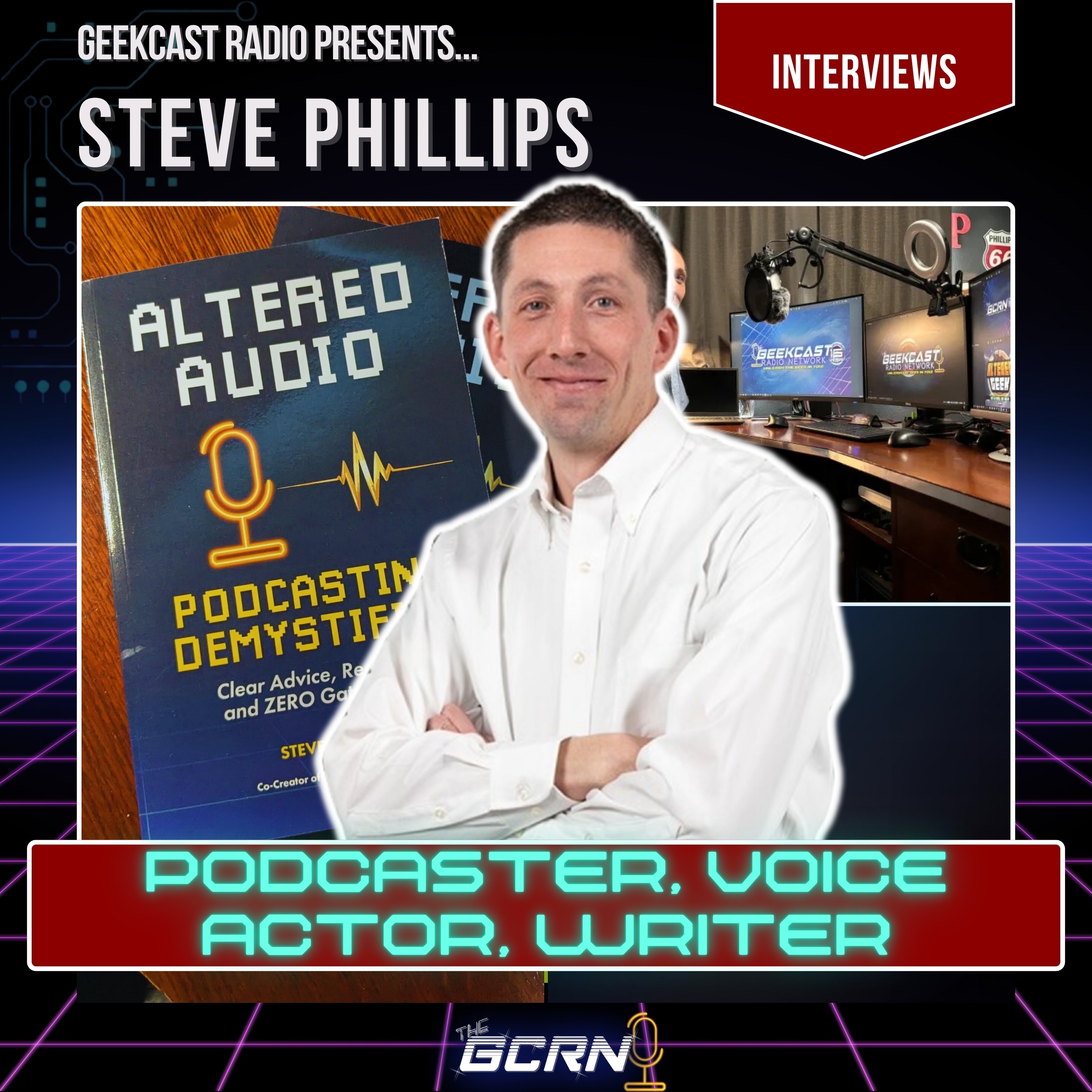
Interview with Steven C. Phillips on Altered Audio
Part of a Collection
About this Episode
Hi, this is Kevin Conroy, and you're listening
to the Geekcast Radio Network. Hello and welcome
to the 350th episode of Geekcast Radio. I am
TF2 and Mike, and today in this special interview
episode, I welcome the co -creator of the Geekcast
Radio Network, a 20 -year podcast veteran, a
voice actor, and now writer, plus my best friend
in the world, it's Stephen C. Phillips! Yeah!
who now has his first book published, entitled
Altered Audio, Podcasting Demystified, a guide
for any and all podcasters with clear advice,
real tools, and zero gatekeeping. Because as
you know, folks, the goal has always been to
unleash the podcasting geek in us all. Hi, Steve.
How are you? Good. How are you? I'm good. See,
the goal there was to basically fake not knowing
you. And congrats on the release of the book.
Any initial thoughts before we jump into the
questions? No, just waiting to be peppered with
questions at this point. Yes, I'm going to assault
you now. Would you like to be a pepper, too?
That's right. I'm a pepper. Don't you want to
be a pepper, too? That's right. It's an old Dr.
Pepper joke. All right, so we got three sections
here, folks. We're going to talk to Steve about
his voice acting, his podcasting, and his writing.
But got about 18 or so questions, maybe a couple
more in the random section. You never know. Starting
out with the voice acting, you say in the book
that the original dream was to be a voice actor.
All these years later, you have gotten to live
that dream in several projects. What was your
favorite part about the voice acting process
that you went through? So when I first got started,
it was on the Transformers Headmasters fan dub.
And I had a piece of crap lab tech. desktop mouse
or not mouse microphone. And it was one of those
$9 microphones, you know, those, those ones that
plug into the, the microphone port. Yep. And
they just sound like crap. And then if you had
like a phone call, they would have like the weird
backfeed. And then if you hit anything and had
a weird backfeed or buzz or yeah, it just, it,
it sounded distant, not very clear, just sounded
like trash. I learned how to do that. And I learned,
uh, cause I was like, I have no idea what to
record these in. And, uh, I was using like windows
sound recorder, uh, cause that was my exposure
to it at that point in time. And, uh, the other
guys in the stuff, they're like, we use gold
wave. And I'm like, what's that? Uh, I'm like,
is that sound wave just different? And they're
like, no, it's gold wave. And, uh, It's essentially
like I don't even know if it still exists, but
it's it's like I at the time. Oh, it does still
exist. They they do a lot of like audio editing.
There's I mean, they have a video editor as well
now, but they have they have multitrack. They
have like 20 bucks to buy. So it's not it's not
bad. And it works on all devices. Like, you can
get it on iOS, Windows, Mac, Linux, and Android
now. I remember using it. It looks nothing like
it looks now. It was very different. And I had
no idea what I was doing in the software. Like,
I just, I didn't. And it was so confusing. There
were so many different settings, so many different
things you could do. And I didn't know anything.
I was recording for the voice of Scourge because
I could do the voice of Scourge. And I was doing
a voice match just like everybody else in the
program and joined in on episode three. And then
every now and again, I actually still to this
day still get we've we've. rebooted with a different
set of people running it at one point and i think
they made it to episode 10 or 11 or something
and then it just kind of fizzled out but it takes
we i get usually like one a year that gets recorded
and so even to this day i still get to do some
random characters in it like i've done dive bomb
i've done superion i've done you know some different
voices but uh That was that's still like the
pinnacle of like awesome because I still have
the original video clips on a hard drive. And
I'm like, I got giddy when I saw my voice on
the animation for the first time. Nice. When
you craft your voices, how do you go about doing
it? What is your method? And I'm not talking
about the impressions. I'm talking about your
unique voices that you create. Uh, so I, I, this
kind of bleeds into both. Uh, so when I, when
I do the voices, I, one, obviously watched a
lot of television and animation as a kid. So
I flipped channels. I watched the, you know,
the one Saturday morning, I watched the Sunday
stuff I watched. I literally flipped. Between
the five or six channels that had cartoons on
Saturdays and then the three that had them on
Sundays. And then I watched weekday mornings
and then weekday evenings. And I watched entirely
too much. So I would play like when I played
with like my action figures and my Lego figures
that I created to mimic the ones that I couldn't
afford to buy because I had a bazillion Lego.
Which, by the way, look nothing like the stuff
that comes out nowadays that's pre articulated
and transforms properly. Oh, definitely imagination.
But. I, I would try and replicate the voice,
and sadly, a lot of them didn't come to fruition
until I hit puberty with my voice deepened and
I was able to actually hit the voice. Uh, but
a lot of the, the, the screen care forces were
a lot easier to do, uh, because obviously voices
are different and they change over the years.
And, uh, so I started out doing like meat wad
and, you know, trying my, my hand at sound waves,
star screen, Megatron beast, Megatron waspinator,
uh, Gollum. Those were a lot of my and Kermit
the Frog. Those were a lot of my foundational
ones. And then I kind of learned how I could
merge other voices to create different voices.
And so I have some original voices like when
I when I have congestion, I can do Morgan Freeman
pretty well, which, yeah, it's an impression,
but it's still like a vocal intonation that I
have to figure out. Even the impressions, I typically
have to learn their speech patterns. Like, I
have to listen to them enough. I have to learn
the speech pattern. I have to replicate it. I
have to hit the right cadence at the right moment
with the right speech pattern. I did that in
my acting class. I played Casey Kasem. And then
I did the Joker. Yeah. So, I mean, there's that.
And then a lot of it, I just pick stuff up. When
we interviewed the guys that did the Ninja Turtle
podcast years ago, and then I come off mute and
I'm like, oh, I can do Krang all of a sudden.
Just practice it five seconds off air, microphone
muted, all of a sudden belt on, and then, you
know, Saki, this is Krang. The devil is my new
body. So, I mean, a lot of those voices just
come out of just hearing them for years and learning
what they say. But when I produced an audio drama
for three and a half years, I couldn't always
do an impression. Right. You had to create your
own. I did. Yeah. So one of the characters was
kind of a play on Beast Megatron, but it wasn't
100 percent Beast Megatron. It was more lighthearted,
more like goofy version of it. And so, like,
I I pitched the the deep and dark and, you know,
and made him more, you know, conversational,
you know, and well, well, well. I hit some of
the same tones, but it was a lot lighter and
a lot different. Then I had to do a talking parakeet,
which I can't do right now just because my throat's
a little raspy on it and dry. I did a talking
parakeet because they had a written -in role
for a talking parakeet. The director just looks
at me and the writer and goes, I don't know how
I'm going to do this. And I said, well, lucky
for you, I had an aunt who's still alive, but
she had a bird when we went to visit in Florida.
And she had a bird named Myron, and it would
talk. it wasn't a parrot it was like it was some
other kind of bird but it could talk like a i
don't know if it was a love bird or something
but yeah he would he would go you know and you
know and so like i i started doing that impression
and they were like there we go It was supposed
to be like a parakeet and I'm like, well, parakeet
don't really talk. They really don't. Yeah. And,
but they wanted it to talk. They wanted to say
just short things like, you know, never going
to stop, never going to stop, you know, and,
and things like that. So I just started speeding
it up and doing it like higher pitched. And then
there was a scene where I had to, uh, get vacuumed.
Like the bird got vacuumed up by accident. Cause
the kid's supposed to be cleaning the cage. And,
They're like, OK, I really don't know what to
do. So I. I said, well, I have this idea. And
the director's like, let's see how it goes. Of
course, you know, Mary is recording for it, too,
because she played my wife in the program because
I cast her that way. And there's this this scene
where our. imaginary son in the program like
the uh that's another kid's another kid not our
own but yeah plays our kid and he goes you know
vacuums him up and the bird's going you know
and and something to that degree and you know
a lot more squeaking and squeech squealing and
and things like that and i i did a quick you
know number of that and director is like it's
great i need it longer and so i'm like i'm like
oh and so i i immediately like just chug some
water gurgled it for a second you know and then
went at it and recorded a couple different takes
of it and and uh he's like throat hurt yet and
i was like yep and uh so i did that and there
was an instance where i had to play a scottish
character which i was trying to do scotty but
i was like he's not off like my impression of
him and james doohan's voice and uh star trek
are not authentic scottish accents like they're
they're just not uh because mine was an impression
of james doohan doing scotty you know a scottish
accent in star trek and i I was just this person
that wrote it was like, I want to see you do
the voice, Steve. And yeah, good luck. And I
was like, gee, thanks. And we didn't have access
to a Scottish actor. And they joked around like
they were going to hire somebody off fiber for
a hot minute there. And then which came to shove
that day. And they're like, I got to get it done
today. I don't have time to wait. What do you
got? Me being the overly critical one, I watched
a butt ton of YouTube videos to get the vocal
pattern and the cadence and the speech pattern
down. And I rewrote all of the dialogue for the
Scottish character so that I could say it exactly
how it needed to be said, like how they trim
the words, how they, you know, the cadence of
it, you know, and. it looked like a mess like
i couldn't even barely read it uh and when i
got down to it i'm like i have no idea what this
is saying at this point like because i translated
it in a sense and so i got in the booth and i
just started you know well how do we got you
know and just kind of added some of those lilts
in there and things and i i'd watched a ton of
them from voice dialect coaches on youtube and
and other people that are Scottish that were
watching, you know, like James Doohan and then
watching, um, I forget the other guy's name,
uh, that did Scotty and the reboot films. Uh,
you know who I'm talking about anyways. Uh, yeah,
my, my brain is having a hard time remembering
actors names anymore, but I, yeah, you know who
I'm talking about. And so anyways, they were
like, his was not too bad. His was a different
dialect, but it works. They were like, James
Doohan is not Scottish. And then they were talking
about Chris Pine doing a Scottish accent. Simon
Pegg, yeah. And so they talked about Chris Pine
doing a spot -on Scottish accent in a film on
Netflix. And, man, I can't remember. It was The
Outlaw King. And it was about Robert the Bruce.
I think I was supposed to be playing the same
character in this script. And I watched this
film four times and mimicked every time they
said something so that I could get the cadence
down and the voice down. Went in, recorded it.
I could probably replicate it if I tried, but
yeah, it's... Uh, it's very difficult. And then
I, I created another character like, uh, uh,
Ranger Bob, which was a take on Patrick Warburton
doing, uh, his role from Emperor's New Groove.
Oh, nice. Uh, crunk. Uh, yeah, the Kuzco that
Kuzco watched, you know, and squirrel squeaky,
squeaky, squeaky, squeaky, squeaky, squeaky,
squeak, you know? And so. I did this weird thing
with my throat the day of. We were doing a live
-action version of whatever this was, and the
character had never been seen before, never been
heard before, never been in anything. And they're
like, so here's the catch. You have to be the
Ranger character, but you have to do a voice
or something, and it's for 12 hours. Yeah, that's
a lot. I got the voice figured out when I was
driving to work at 730 in the morning. Same person
that wrote the Scottish thing wrote this. I knew
I was screwed. So they had the best intentions,
but still. So anyways, I went in and I was like,
this is what I got. And they were like, ooh,
like, you know, like that moment where you hear
David Kaye talk about, you know, the voice at
the control room, you know, all of them looking
around like. Yep. You know, dinosaurs looking
at each other like, Ooh, that's good. You know,
or Camille, uh, yeah, whatever. And, and so anyways,
I did the voice and I was, I later figured out
a better way of doing it without having to cause
the throat strain that I was doing, uh, before,
but I don't even joke. I got this voice figured
out. I could not get out of the voice. for 12
hours because I tried at one point during lunch
to talk normal and I lost the voice and I still
had like six hours left to shoot and I was like
alright I gotta go outside for a few minutes
I gotta go get this thing back and I listened
to my recording that I sent earlier in the morning
and I'm like how did I do this again and so now
this is the voice of Ranger Bob So he kind of
talks like this when he's talking and, you know,
the squirrelies and yeah. So I kind of evolved
it from Patrick Warburton to more my own thing.
And, you know, he's like, oh, affirmative, you
know, kind of like he's like some weird, goofy
military guy, but he's actually a park ranger.
And then there's literally like a scene in the
show that he. talks like a squirrel or doesn't
talk like a squirrel but he's like i gotta go
find my nature friends and see what the squirrels
are doing you know or something like that and
there was a whole mini series with him doing
like nature nuggets for kids or whatever and
like i came up with the premise and then i was
like okay now i gotta do the voice through all
of them yep absolutely all right switching over
to podcasting this this One is more of a diatribe
than anything else. But in the book, you chronicle
your podcasting journey, so we want readers to
be able to read it for themselves. But 20 years
later, did you ever think you'd have a network
with 20 or more podcast shows that equal over
4 ,000 episodes covering many different geeky
topics, of which the numbers are futsy with me
on this, but 85 % you're a voice on. Sounds about
right. No, I didn't think I would still be doing
this, to be honest. Not to mention the fact that
I, one, starting off with TFWire and doing 15
War Story episodes, doing an episode of PlayOn,
doing an episode of TFWire proper, and then doing
all things Transformers. brainstorming all these
other shows getting to collaborate with like
twig and tf anonymous and uh so many other different
you know what's on your mind and all these other
programs that i'm sure i'm forgetting quite a
few at this point um but no i didn't i didn't
see myself doing as many, like I I've probably
done more podcasts than what I can remember at
this point, including like, you know, the, the,
the kids podcasts that I produced, like I did
a number of those and I wrote a number of those
and those are dramatizations. And so those are
different. I did some for my kids, uh, school
spirit day for years. And, um, now weirdly enough,
I've been going around and I don't know if this
cuts into another question because I have no
frame of reference here. You devil. I weirdly
enough have been getting asked more and more
to speak and present on podcasting more locally
than anything else. But I do have another like
I actually have a like almost a webinar live
stream type thing awesome coming at the end of
september uh actually for uh a bigger organization
so uh then then just a local thing which don't
get me wrong i love doing the local thing and
i love talking to the kids as long as they're
receptive um but that's i'm super geeked for
that plus uh i like the community and the community
doesn't cost me anything to be in I'm actually,
I'm writing an article right now about podcast
associations. So that's, that's going to be a
fun one. I'm sure I'm going to burn some bridges
by accident, but I, I have some strong words
to say on that. But anyways, yeah, I, it's, it's
definitely been interesting and I've always dreamed
of writing a book. So this is something cool,
like getting to design it, getting to see it
in print form. I have multiple copies of my own
book sitting around. I have one in my display
cabinet now. Nice. I have one, which that's the
Barnes & Noble one, which I'm like, okay, that
one's my other proof copy that's in pristine
condition. My Amazon versions is not for resale.
um mike both my boys have read through or ian's
still reading through it um he loves the anecdotes
like he's i think he got bored he got bored when
the anecdotes ran out um because like he's he
he got stalled on chapter three and then he's
just kind of like i'll get back to it soon um
um he's like, cause he was asking me all kinds
of questions when he was going through like the
intro and the pro, you know, the, the prologue
and the, you know, chapter one, chapter two.
And so it was, it was, it was interesting going
through that, but yeah, I would have never seen
doing as many podcasts as I've done and writing
a book or getting to teach about it, which. oddly
enough, I enjoy, even though I'm not like this
award winning podcaster or, uh, you know, somebody
that's getting asked to these big events or,
or, or paying for these, these big, uh, uh, podcast
associations or, uh, you know, just because I
haven't done those particular things doesn't
mean I don't know what to do. Yeah. It's more
so. I don't have the time or the funds to do
what some of these people are, you know, getting
on the road running with. Uh, and it's because,
and again, that's why clear advice, real tools
and zero gatekeeping. That's, I'm not trying
to like, I'm not trying to lie to people in the
book and go, Oh, if you buy my book, you'll make
money. You'll be a big time podcaster. It's like,
no, it's like it's work. these are the tools
that I've seen. These are the evolutions of things.
These are the places to find what you need without
having to do like a bazillion Google searches
and try and find what actually works. And so
that was kind of my premise for this was like,
I want to help people figure out like, this is
easy street, like skim through, find what you're
looking for and not, not deal with like, cause
honestly you don't need the gear. it doesn't
matter. Like, I mean, you can record on your
phone nowadays. Like I've done it. I've recorded,
you know, conversing with you and Kai on discord
and not even had a microphone hooked up and it
sounded just fine. Yeah. So it's technology has
evolved. Things have gotten better. Like it's
no longer the, you know, the cracker Jack box,
uh, microphones of the, the lab tech days, which
is why they're gone. The lodge attacks, Mike's
sucked until they bought Yeti. And now they've
kind of, bastardize those too but i mean yeah
i mean that's that's kind of that that's why
i'm i'm a huge proponent for indie podcaster
not corporate podcaster yep absolutely all right
so after the recording of an episode of say all
things transformers or altered geek what is your
editing process like do you edit it immediately
do you edit it the next Whenever you have the
time to, how much time are you putting in these
days on the editing versus the old days? So the
old days, I will definitely say I put a lot more
time. But it was also different. So back in the
old days, we either recorded through Skype. Originally,
we both recorded on Audacity. And then we had
to sync up the files. audacity didn't play well
no with the stream and so we would have to chop
and cut and and audacity did not have multi -track
back then no so it was not fun uh you could easily
screw something up which is why i like the one
beverly hills cop episode with uh or die hard
with with dodd or mike birdman um that's why
that particular episode was like like whatever
was wrong with it like super slow or non -existent
audio um and then granted i listening back to
that because i list relisten to m wire 200 just
because i'm planning the revival yeah and i was
listening to it and i was like you know listening
back to this i know what happened I literally
know what happened, but I didn't know what I
didn't know back then. And so it was it one.
It was how it imported. But two, it was a setting
and audacity that neutered the file more or less.
And so but I mean, like and then looking back
at like, you know, our first interview with David
Kaye where we had the buzzing. Yeah, I could
run that through an AI filter now and clean it
up completely. Yeah. Like easily. easily but
i also learned how almost like eight years later
how to use the spectrographic cleanup and cleaned
the majority of it up anyway so i mean there's
with each you know amount of time that goes by
things evolve and get better and um I forgot
where I was going with the question, but... Things
evolve in time, and things get better over time,
and new tools. Yeah, I mean, I've just seen a
lot of stuff change. My editing, though, getting
back to the original question, back then it was
a lot more tedious, a lot more time -consuming.
I had the intro, I had the outro, which the outros
were fun and goofy for the time. You've just
listened to a podcast on the Geekcast radio network.
You can follow us in the following ways. On Facebook,
blah, blah, blah. Until next time, unleash the
geek in you. It doesn't work nowadays, but it
was funny back then. Kind of a staple of that
old era. and the gamer clans and that kind of
stuff. But I spent a lot more time doing it then,
and then when we started using Adobe Sound Booth,
I believe. That sounds about right. It was Sound
Booth before Audition. It had its own issues
with things. And I can't remember. There were
some goofiness things with that, too. I can't
quite remember all of it. I also had a version
that could run off of a flash drive at one point.
Damn. Well, it was like a mobile version that
I stumbled across. And I put it on because it
didn't need to install. You could just run it
right from the flash drive. Right. Yeah. And
so I used that for years because it was easier
when I was on the go or like when I was out somewhere
or like when I worked at the dealership, I had
I had a computer that I used in between, you
know, work and things that I had going on. Like
my lunches, I would I would literally edit on
lunch or I would edit college classes. And I
learned how to do all this stuff through that.
And then. uh, eventually got audition when they
phased out sound booth and audition was better
and had a lot more features and was just capable
of a lot more audio formats. Uh, whereas sound
booth wasn't like, I think it couldn't even run
a C files or something. Like it was just wave
and MP3 and M4A or something. And that was it.
Uh, and so when I got audition, like I started
building out, like now I have, I have prebuilt
templates for like all things Transformers and
the Cyber Dragon Ball and Altered Geek. And I
leave like the spot for the voice promo. I have
the spot for the intro. I have the spot for the
outro. And I, of course, like the outro, I drag
it depending on the length of the episode. But
I have them all on individual tracks. I have
them all with certain presets in Audition so
that I don't have to. finagle with it and then
uh and then i literally import from our our discord
recordings yeah the the multi -track so like
i get your audio my audio and then i put them
on different tracks and then just make sure like
i drag them to the beginning of the the time
frame making sure that they line up 100 and then
and then i move them further down past the intro
or like where the transition starts happening
yeah and uh So then I, then I kind of, I skim
it because generally if we're recording an episode,
I can tell if it's going to need editing. Yep.
I don't always take timestamps. Sometimes I should,
but if, if I notice something going AWOL on it,
I will look at the discord recording, see where
the timestamp is, make a mental note of it, you
know, on a notepad. And, uh, seek it out once
i've imported it into the multitrack but um for
the most part i listen to hear like i i have
the presets for audition in there where it'll
it'll level it it'll put a loudness filter it'll
it'll tweak certain other things and kind of
automate it um it's not ai it's just presets
podcast presets so it'll boost things they need
to be boosted and lower other things and uh i
have i have like 12 different presets depending
on what it is so i have music one i have like
podcast ones i have three different of those
and then i have other ones that i've used for
audio drama stuff that are variations and i've
tweaked different parts of it and then i i kind
of scrub through and if I know that there's a
bunch of ums or like sneezes or, uh, me clicking
the mouse. Cause oftentimes I'm multitasking
while I'm recording, uh, which I know that the
click, click, click, click, click, click, click,
uh, is super annoying to people. Cause I've,
I've gone back and actually listened to them
and I can tell where I'm paying attention and
where I'm not. Uh, and Amware 200. Oh no. I,
well, I was listening to them where 200 and I'm
like, okay i think i totally well i didn't edit
it you did so i wasn't actively paying attention
to what was going on like i mean i was paying
attention to the conversation but i think i was
playing star trek online oh i'm sure you were
because i was laid off and i was like it was
my i think my first layoff and i was like yeah
whatever yeah no no uh or maybe it was my second
layoff i don't know but it was it was funny regardless
and i i was listening to it i'm like okay i am
annoying uh no you're not no i meant the clicking
the click yeah i understand and and i'm gonna
say something here folks and he knows better
than this because i'm not trying to insult him
but oh my god i want five dollars for every um
i have to cut for me yes per episode And most
people will say, oh, but you can leave that in.
And I'm sitting here thinking, no, you can't.
There's a perfectly good way to sit here and
have a conversation and talk to someone. So they
do have software now. It's called Descript, and
it will scan and create a transcript of the entire
episode. And you can have it. find the verbal
crutches and remove them and it tightens up the
audio automatically how much does it cost and
is it i have no idea but it's it is a i know
they have a free version but i know that it uses
part of the cloud to uh filter it and to clean
it up but it does it does do that like it will
show you the transcript you can go through and
find all the ums or the uhs or the the other
double double word yeah verbal crutches and it'll
go through and it'll remove them all nice and
so they do have software out there uh i'm trying
out a new one from uh daniel j lewis right now
that i'm on the beta test for and i can't say
what the name of it is granted i don't remember
what the name of it is but it's fine it it helps
build chapters and it helps build like time for
like more of like a an outline of the episode
itself yeah so basically like when i said okay
this is the voice acting section this is the
podcasting section and then up next will be the
writing section yeah so i mean it'll it'll agree
yeah it'll do that and the id3 tags and the it'll
do all of that and it uses a little bit of ai
but a lot of the features are just like manual
yeah you you put you dump your file in there
it automates and it it does a lot of this stuff
I'm actually working and, and he's like, Oh,
I can't, I put it together in three weeks and
I'm like, okay, I know you used AI. So I, which
everybody's doing that. I've, I'm guilty of it.
I've, I've created a couple of, uh, I've created
a couple of the plugins for geekcastradio .com
using AI because one, I'm too cheap to pay somebody.
To, you know, more or less, it's if it's a subscription.
Yeah. And I need a simple feature and I need
it to work like it's not it's not something that's
like, oh, I'm going to have it generate me an
SEO app or I'm going to have it generate a podcasting
plug in or newsletter plug in or, you know, pass
keys or, you know, something something to that
degree. I'm not having it mess with because there
are better features out there. There's better
things that are more maintained, paid more attention
to. I don't pay attention to how WordPress functions
like it's just not in my wheelhouse. So this
particular one that I created, I ran it through
AI and I because we used to use like a featured
image plug in and it would. It was like, I forget
what it was called, but it was, it was for featured
images and it would allow you to quickly change
them based on category, or you could click on
it in the episode or the, the post list. And
I won the one that was available was getting
bigger and more bloated because we've been using
it. I don't know, 2012. Yep. like way back when
oh yeah because i you know we've changed websites
and i've i wanted something with like quick editing
and it got to be super bloated and there were
just more features and it got ad heavy and i
was like you know every time they add all these
ads it's slowing down the website but it's also
a security risk yep and so well yes i do have
Certain things, you know, Jetpack on their newsletters,
podcast importers from like Second Line, things
for the theme. I don't like I was going to have
it generate our own comments plug in. And I was
I was going through AI working it out with it.
And it literally told me out of the features
you're looking to have. this particular one is
the one you want. It's like, unless you want
to sit here and develop a brand new one, which
will take weeks to a month, you know, months.
Yeah. This is what you want. And I was like,
touche. I was like, you save me time. You save
me effort. If a better mousetrap works, you know,
is there, right. I'll, I'll go with it. Uh, anyways,
I created the, the, you know, a featured image
plugin, which is the only one that I have actively
running right now. I have some others. I'm, playing
around with and tweaking and messing with. But
this one, I got all the features I wanted. There's
no crazy dashboard, no crazy settings thing.
It's just literally, it works. And again, you're
using the artificial intelligence as a tool.
I'm using it as a tool to write the code. I'm
telling it what I want. And then I'm troubleshooting
it. I'm testing it. I'm seeing if it works. It
does what I want. And then I'm working on the
UI with it. Uh, but, and I'm developing a couple
other ones. I'm actually working on a, an actual
standalone program that I'm, because we're talking
about editing. It reminded me where I wanted
to automate all of these things, but where you
can drop in the raw files, it will slap on the
intro outro. It will, you know, things like that.
Like, but I don't, I want it as a standalone
program. where one you could plug it in with
an api through ai if you so chose yeah like transcripts
or things like that my main goal with it is 90
of these different things people want easy and
then also 90 of the things out there are subscription
an indie podcaster does not have the money no
I don't have the money. Like, I mean, I could
pay for it. Yes. But if I paid for every service
that had a subscription, it'd be like paying
for cable television. Pretty much. Yeah. So I'm,
I'm very, and as I've mentioned, I'm very indie
podcaster. I'm not for the corporate people.
I'm not for these people that are trying to sell
a product. Like, yes, I'm trying to sell a product.
My thing would be a one time. Oh yeah. I don't,
I don't, I want it to work. You know, it's like
level later. Yep. That thing doesn't exist anymore.
I mean, unless you have it. And it essentially
would also have that type of thing built into
it. But I'm not taking anybody's code. I'm not
doing it. I mean, I don't know where the AI,
you know, designs it. And I will say 60 % of
the time, the code don't work. Because I've had
that issue with even my WordPress plugin. And
it's very much a trial and error thing. And,
you know, when I get something that works, I
let it know. And then it tweaks it, troubleshoots
it. And, you know, we kind of build it collaboratively.
And so my goal is to create this thing where
it's like a one -time purchase and it's not like
stupid expensive. Yeah, I mean, there'll be a
kickback towards me on it. But, I mean, it's
not. It's nothing that's going to break the bank.
It's well under the price of a video game. Oh,
yeah. But again, just because it's a kickback
towards you, you're obviously going to then put
that back into the website or back into the production
cost. 100%. I mean, we're not out here making
money, folks. Like we said earlier, we've never,
never been doing this to make. buku bank of money
or anything like that or whatever i mean if we
ever made money great like if we ever got paid
collectively like you know yeah but i mean i
i'm also not under the flag of being like oh
we got bought by amazon we're wondering we're
also not gonna have jobs like yeah exactly yeah
so i mean it's that that kind of thing like i'm
trying to i i don't i don't love modern like
where modern podcasting is going because you're
getting all these like people trying to sell
a product all these fire these hothead corporate
people for these big corporations trying to sell
their product and trying to rip people off and
it's like dude just i mean that's that's again
that's why the book like i just yeah it's not
an expensive book it's not it gives you the keys
to stuff it's not a dummy's book where it's like
eight times the size of my book and and costs
you know 30 bucks or whatever like yeah i mean
mine's a fraction of the cost but it's this literally
will fit you know this is this is like a production
handbook that you can carry with you and it's
lightweight and yeah so absolutely all right
back to back questions here what is your favorite
type of podcast episode to listen to news storytelling
or review show It depends what it is. Okay, well,
storytelling specifically to give you something
like podcast approach or origins or something
like that where a story is being told. So they
all kind of boil down to am I interested in the
topic and am I going to learn something? Okay.
Because if I don't... if I don't find value in
the topic nature or, I mean, the guests matters
to some degree. Like I, I will fully admit there
are some origins people. I don't listen to their
episodes because I don't know who they are and
doesn't resonate. So there's one that there's
also the familiarity and like, do I know who
this is? Do I know what this is for? Like, you
know, I'll listen to, a review show a lot more
often but i also do listen to some new shows
like i there's some video shows on on youtube
that you know i'll listen to that i don't know
if they have a podcast component but i do listen
to some of them but i'll also go back and listen
to some of our old stuff because i'm i can't
honestly remember what we said It's like, you
know, the M wire 200. I didn't remember any of
that. Like, yeah, but I also recorded it forever
ago. And so it's, it's very much just one. I'm
getting older. My memory is not as great as it
once was. Plus I don't, I'm dealing with different
stress stuff in my life now that I didn't have
then. And granted, it's not as bad as back then,
but still. Uh, there's just more things occupying
it, but like I was relistening to, cause I was
sharing it with somebody on discord. I was relistening
to the 4 ,000th episode of all things, the overall
4 ,000th episode of the network. And in that
episode, I said, generally, if you tell me an
episode number of any of our podcasts that I've
been on, I can tell you what topic it is. Like
if you tell me tune cast episode, one well that's
the nintendo tunes if you tell me tooncast episode
10 that's he -man and shira like i can do that
kind of stuff but i couldn't tell you what in
the hell was said on that episode i would have
to actually go back and listen to it kind of
thing and uh and yeah but yeah i don't know i
think for me when it comes anyway uh so here
we go what is your the the opposite end of this
this question. What is your favorite type of
podcast episode to produce? Same thing. News,
storytelling, review show. I think they all kind
of tie into one at certain times. Kind of. Sometimes
they do. I like the news shows just to kind of
keep up on stuff. And then I also like the review
shows because, again, I can also do that. But
yeah, I, I don't know. I, I, I am, I'm a fan
of all of them to some degree. It just depends
on the topic nature. Yeah, absolutely. All right.
Two more questions in this category. Then we
get to the writing. What did you see as your
biggest challenge in podcasting 20 years ago?
And what do you see as your biggest challenges
today in 2025? 20 years ago. Hand coding the
website? That's right. I absolutely hated that.
And I tell people, do you remember the day when
you used to have to hand code your RSS feed?
Well, I do. I remember doing the art. I remember
doing the website. I remember having to manually
update the website because it wasn't automate.
I remember having to manually do the RSS feeds.
I remember having to. Yeah. And edit and then
somehow find time to be like, oh, I'm going to
produce more episodes. And somehow we recorded
like four to five to six episodes a week, sometimes
three a night. Yep. So that's how we recorded
four to five episodes a week. We would do three
a night. That's how we got. I honestly don't,
I don't know how I had the time for that. I mean,
granted different, different place in life, but
yeah, but yeah, I mean, it, it, it definitely
was a different, a different beast back then.
Nowadays, nowadays it's, It's mostly just finding
time to record. Yeah. I, I have all these ideas.
I have all these shows I want to do. Like I want
to do, I would love to get back to, to weekly
alter geeks or, and you know, all things transformers
and have more regular cadence with the cyber
dragon ball. Cause like I have the scripts written
for the next like two episodes of that. I'd like
to get time to do altered track or even edit
the episode that I have. And, uh, and, and I've,
I've even toyed around with, I was going to bring
back the internet pathfinder, but I was like,
you know, that shows so far dead and removed.
I'm better off doing a brand new show for altered
audio. Yep. And kind of going from there. Uh,
I also want to do the video show of M wire and
see if I can actually pull off a video show.
Yeah. Very cool. And so, like, I have all these
ideas and all these, like, projects I want to
do and not enough time to do them. Yes. Well,
when we get to the point of Altered Trek, we
definitely have to record a preamble intro for
that original episode we recorded because that
thing is sold at this point. And we're not rerecording
that episode. We just need to slap an intro on
it. Which I will. Yeah. Yeah. And one of these
days I'll actually get that episode done. It's
just, I, again, time I'm hoping my goal is to
get it done in the next couple of weeks because
I finally have the, the L cars, uh, segment.
So I have the, I have the next episodes, all
cars done too. I, I intentionally did the, well,
those, well, those I, I recorded with, I used
AI for those, but it was mostly because I was
looking for like, not the, not the text, but
like the vocals, because I was trying to get
like the computer, you know, the library computer,
uh, speech and yeah. Or as close to it as I can
get. Yeah. Yeah. So absolutely. All right. Final
question in this section for podcasting. What
is one piece of podcasting advice you want to
give the listeners that is not in the book? It's
like asking me if I remember what I put in the
book at this point, but mostly just if something's
exciting to you and something you, you feel like
isn't being covered by somebody else, there is
place for you. Like there's not, the podcasting
is not like, well, there's already 50 ,000 other
shows doing the same thing. Well, how many of
those are actually active, you know? And so it's,
it's, you know, do your research with it, but
there's, there's room for everybody. There really
is like, and everybody has a different opinion.
Everybody has a different perspective. Everybody
has a different interest or level of interest
of something, you know? there there's literally
millions of avenues and in, in directions and
perspectives that you could take it from. And
I, I'm, I'm in this, this group with our, our
podcast hosts, rss .com and the RSS space. And
I'm literally seeing different things that I
was like, Oh, I didn't, I didn't even think of
that angle. I didn't, that's a great idea. I
didn't think about that, you know? Cause it's
like, I, I literally, it just didn't occur to
me because we've always kind of done our status
quo and how we've done things. And, uh, I mean,
we've taken different angles and evolved them,
but, but it's still different because we didn't
think of it like these people did. Yeah. There
are some things we were groundbreaking and doing
before other people took it on like the beast
wars podcast or, you know, a lot of the review
content. Yeah. Uh, that's why we were big until
like, close to 2016 when it kind of, the bubble
burst and everybody got in and then it got big
again during COVID. Yeah. And then that bubble
burst again because a lot of people that got
involved with it jumped off after. Yeah. Yeah.
Cause everybody was at home and everybody didn't
have anything to do. And there, everybody found
podcasting. It was like, Oh my God, we can just
sit at home and talk to each other. Oh shit.
Sherlock. But yeah. Yeah. All right, time to
get into the writing. So just to give a little
preamble here, folks, we know this interview
is all about the Steve, but background here on
me, I've been writing for 31 years. I was 14
years old when I first started writing back in
1994. Many different things. I considered myself
a writer before a podcaster, and now I'm obviously
a podcaster and a writer. And I'm saying all
this in order to ask you, Steve, have you ever
had you ever had the writing bug? Were you a
voracious reader as a kid? Because that's what
got me into wanting to be a writer. I read a
lot of books as a kid in the 80s. So what got
you into the whole writing thing? So in the 90s.
I used to read a crap load of books. I burned
through books like no other. My mom took me to
use bookstores. Uh, I had, I had a couple of
shelves. I, she had like, I mean, we had kids
books galore, like in, in our, our bedroom with
a bookcase my dad built and it was pretty hefty.
I mean, it was probably about four foot. It's
probably like four foot wide by like five foot
tall, full of books that we had. They were all,
you know, you know, your your classics or your
Disney or your, you know, various stuff that
you get from the Scholastic or the book fair
or things like that. And my mom has some of that
stuff still. And my brother has the rest of it.
And I got some of the books. And so I had, you
know, Power Rangers, G .I. Joe. I had. buttload
of comic books that were coming I loved Star
Trek back then and read all of the pretty much
any book that had to do with Kirk or the books
written by William Shatner for Star Trek I had
and I read the I read them all and they were
you know like three three hundred and four hundred
page books and I would take them to school. I'd
read them. So I had a huge vocabulary, at least
while writing. Vocally, I don't speak as intelligently
as I write. And there's oftentimes I write a
word down. I have no idea what it means, but
I know it fits in the sentence. And I know that's
the right word. I just, you know, I can't define
it or know what it is. But it's somewhere in
my brain where it's like, no, this is right.
I'm telling you. And I'll look it up and I'm
usually like 99 % of the time it's it fits. But
no, I used to I used to read a ton of those books.
I used to go to the bookstore. I used to get
comics. I used to watch, like I said, a crap
ton of animation and film and television series
and all these different storylines floating around
in my brain. I'd play with. uh the action figures
and the lego and i'd build my own scenarios my
own storylines then i started writing my own
and recording them on uh video which i the the
timing of this is so ironic i i was digging through
my desk looking for something the other day i
can't remember what and i found these old home
videos that my brother had transferred from vhs
to dvd nice and like we have like we we have
like our like our christmas one from like 89
to 96 and then we have like a general one which
was like i don't even know what's on it from
but from 89 to 91 just random stuff with like
one of those old sylvania yep camcorders that
are yep huge and then there's another one that
says steve's home videos which is from 94 to
97 which butts right up against time of star
trek generations coming out and my parents getting
a divorce since we had the basement converted
into a makeshift enterprise bridge oh wow so
we put masking tape on the floor for the transporter
we had you know a pool we had a air hockey table
we had a tv which And then we had a computer
system which I had the red alert sound recorded
from the TV. And then I had created my own graphics
for the red alert on the screen. And we had a
computer chair that looked like the Enterprise
A's computer, you know, the captain's chair.
Of course, my brother's got the crappy chairs
and I got the nice one. just nature of the beast
and, you know, dressed in the stuff and had all
these weird storylines going on. And then there's
other ones where I know I'm recording in front
of a, uh, like stories that I wrote on paper
or a typewriter or word processor, uh, that I
would read in front of the camera. And yeah,
it'll be interesting to go back through that.
Cause I've, like I said, I have no idea what's
on it, but. It'll be fun. Very cool. Very cool.
How would you define your writing style for altered
audio and beyond this first book? Uh, very conversational,
very kind of anecdote, very, I used a lot of
plain English and, you know, in some regards,
some metaphors and, uh, spelling it out for people.
More or less, I'm being very frank with people,
very open. It's like, you've got a voice. Use
it. Here comes the part most creators dread,
where most of the magic happens post -production.
That's right. It isn't just about cleanup. it's,
it's, you know, a lot of mindset stuff. It's
a lot of like reframing how you're, you're thinking
about things and, you know, it's kind of showing
that, you know, I, a lot of the, the content
is fly by the seat of your pants. See what works.
Pivot. Yep. Cause I mean, I even named drop,
you know, ATTF, ultra geek, M wire. you know
even the you know i even touch on like burnout
yep absolutely it's like and why you came back
you know you know the the podcast feed quieted
you know life got loud mike sat still until listeners
spoke up you know miss your voice is all three
all things transformers coming back your show
helped me through a rough patch you know I was
like, I didn't relaunch for the metrics. I did
it for the connection, for the conversation.
We've never done this for the metrics. No, I
mean, I don't give a rip. If people love it and
listen to it, the metrics show that it's resonating,
great. I'm still going to record an episode.
Exactly. It doesn't mean that you can't evolve
or get better with your craft. It's just... making
sure that what you're putting out there is better
or resonating or giving somebody something entertaining
to listen to and, you know, educational, giving
them a piece that makes them a part of the conversation.
That's, and that's why I started podcasting.
It's because I enjoy the conversation. I enjoy
geeking out with other people. It's why I kind
of wanted to do this in the first place. Plus,
I've always wanted to be on radio. Now that I've
worked in marketing, I realize I don't want to
work in radio. Podcasting has always been the
new radio for me. It is. That's what I mean.
I'll do podcasting because I can't get fired
from that. Because we run the show. Exactly.
That's kind of where I'm going with that. Exactly.
How did AA begin? What was the initial outlook
at it? The idea for it? Yeah. It started because,
honestly, it was in the RSS space for our podcast
hosting company. And I was getting asked some
of the same questions over and over. And then
I had people in real life asking me that. Okay.
A lot of stuff. And then I've been going to a
lot of stuff speaking publicly. And I'm like,
you know... I've been writing a lot of articles.
I've been making a lot of posts. I've been dropping
a lot of little nuggets of information. I should
probably put this in one place. Yep. There you
go. And so I was like, I need to put this all
together. And when I started writing it, a lot
of it was... I had a lot of redundancies in places
like I had chapters going and there were some
redundancies between chapters. And I was like,
I was like, cause like I did use some AI, but
it was mostly layout. Yeah. And I was like, where
am I repeating this? Where can I, you know, where
can I make it more concise or like. can I merge
this with this and have it still make sense?
Cause like, I was trying to wrap my head around.
I'm like, both are great information. However,
don't need to re say the same thing in two chapters.
Yep. And so I was able to, like, it was like
telling me how I could reframe it. And I was
like, okay, so I can put it here and I can do
this with it. And I can, you know, so it was
able to make it cohesive. on on my own and it
was great uh being able to to throw a lot of
that in there and like i i a lot of it was just
kind of making sure i had a place to put it because
like i've i've probably i've i've forgotten more
than i'll remember on podcasting and like i was
taking like articles i wrote from years ago and
uh, on podcasting and on audio editing in general.
Uh, because I've, I've done both sides of it.
Like I, I, I have a media degree and then I have
a slideshow that I was using for my, for my,
my speaking engagements. And a lot of that's
in here. Like, and then, uh, a lot of the resources.
A lot of the different types of stuff. Like I
was, I was just honestly trying to put it all
in one spot because again, I don't, I don't remember
stuff very well. Yeah. Well, you kind of answered
sort of the next two questions, but I'll say
them anyway. After you had the kernel of the
idea, how did you refine and polish it? And then
what was the formatting process like? Formatting
was interesting because each platform has a different
one. Amazon, Kindle Press, or KDP Press, it has
one style. And then Barnes & Noble Press has
a different. IngramSpark has a slightly different
one. And then the Kindle, like the e -book, you
had to convert in a certain way. And every time
I tried to do it one way, it kept throwing off
the formatting. Funny enough, I was able to because
I built all this in a Word document. I started
off in a Google doc and it was just coming out
weird. And so I was like, I need to do this in
Word proper. And so I was just I was formatting
it, making sure it's spaced right, doing the
page breaks. And then I had to learn that you
because I have the specialized font for the logo
for altered audio and, you know, the cover page
on the inside. It. I figured out how you embed
fonts into the file. Which I didn't know how
to do before, and I had to Google it and then
building the table of contents was was interesting
because, I mean, it's got an automated thing
and it goes by like the headlines and. the or
the headers like h1 h2 h3 that kind of stuff
and then the cover that was a colossal pain oh
no well i designed the one i i asked ai to create
me a cover logo this is not ai created right
um but i did it because i was trying to narrow
down what i was going for right and so i was
describing it and i was kind of doing it And
as you know, with AI, every time you ask it something
or every time you refine one little piece somewhere
and tell it to leave everything else the same,
it does not. So I would have it tweak something
and then it would screw something else up. And
then I'd have it tweak something else and it
would screw something else up. And at first I
was going to cheat and just let AI just make
the artwork. And then I started getting irritated.
And I'm like, this is not what I want. This is
not what I want. and it showed me one good copy
at one point with the overall like shape and
design, but a lot of the colors were wrong or
the fonts were wrong or the, but it gave me like
the structure of how it should look. Right. And
so I, I was able to put it all together. I actually
think the waveform that's on it is the only thing
that's AI generated. Wow. The, the, the neon
microphone that's from the geek cast radio logo
that I created for that altered audio is just
a different variation of the font of altered
geek. Originally I was going to use the altered
geek font, but I was like, eh, it doesn't quite
fit. It just looks weird. Yeah. And then podcasting
demystified like it, I was going for the same,
you know, font. Then I wanted a clean font, which
I think it's future for the rest of it. And then
I put the GCR and logo and then the binder, the
binding part of it was, kind of strange like
my name centered podcasting demystified is almost
centered and then the microphone is not centered
on the binding which whatever it's it's a first
edition i'm sure i'll have another one later
yeah but and then i had to figure out how to
put the about the author and you know leave room
for the upc code because in the templates it
doesn't tell you where to put it yeah they just
insert it wherever and i could have you know
But what's funny is between my Barnes & Noble
version and my Amazon version is the Barnes &
Noble one came out better. Binding -wise. Wow.
On the covers. I think I had to do a slight tweak,
but the Amazon one doesn't... The other thing
I was kind of disappointed is Amazon does not
take care of the book when they ship it. Oh.
as well as Barnes & Noble. Barnes & Noble had
this thing in a cardboard box. Yep. Packed in
there tight. It was not going to get bent, no
matter what you did to it. The Amazon one, not
for resale, was in good condition before my son
got a hold of it. Okay. But it seems to get the
scratches and a little bit of the dings a little
bit easier than the other one. I've gotten since
two more from Amazon because I'm going to be
shopping those around locally just to see if
I can get them in the store. But the process
was different. But I had to use a third -party
website to convert the PDF of the thing for an
EPUB file for the Kindle. Because the software
that came with the Kindle was just a nightmare
to deal with. Like, cause you, you have to use
their software if you want to convert it or you
can upload a finished file. And I was like, I'm
not doing this. I sent him a finished file and
it worked. So yeah, I learned different things
through different publishers. Like I get more
of a cut if it's direct from Amazon or Barnes
and Noble .com. If it's the higher priced version
of the same book. on IngramSpark, which, again,
it publishes to both of those places. So, I mean,
I could have just done it through IngramSpark
from the start. But the problem with it is I
don't get much of it cut from the IngramSpark
version, which is funny. That's weird. So, yeah.
That's very weird. Well, you've talked about
the formatting. You've talked about the self
-publishing process and things like that and
how easy or difficult it was. So how did you
approach this knowing everything? Did you approach
it knowing everything you wanted it to be? Or
was it a project that changed over the time as
you created it? It slowly changed. I honestly
wasn't sure how much was going to go into this.
And every time I thought I was getting closer
to being done, I would have a conversation with
somebody in the RSS space. And then I was like,
oh, another nugget. Oh, I would, I would write
out all these, like these different things are,
you know, articulating something. And like, I,
I literally, I crap you not dude. I probably
have another like 10 to 15, maybe even 20 pages
worth of stuff saved in another document for,
to incorporate for a second edition of this book,
which means the next one will probably come out,
you know, next year or something. Like I'm not
going to release them as close together. coming
august 2026 might even be sooner it might be
like may or june but but you know what i mean
but yeah but i'll i'll probably have a second
edition of the book yeah i'll probably tweak
some of the covering i'll probably tweak you
know to more or less differentiate it from v1
to v2 yeah and uh i i definitely have more stuff
to add to it i was like Part of me was like,
do I hold off on releasing and just put these
in there? Or what do I do? What's the best method
here? Do I just continue with my original plan
and just save these for V2? Or do I pump the
brakes on it and put them in there? And I'm like,
well, if I do that, then I'm probably going to
be pushing it out another month. I would just
wait for V2. Yeah, I was like, honestly, there's
gonna be enough stuff that changes. I'm probably
going to have to redo some of what's in this
book now, because even one of the newsletters
that one of the podcast newsletters I dropped
in here by Chris Peterson download. He just sent
out an email today saying that he's done with
his newsletter because he got picked up by another
organization in podcasting. So, so like literally
like that information is outdated. Yeah. But
I mean, I have other things I would put in here,
like, you know, podcast conventions or podcast
associations, audio dramas. Like, I mean, there's,
there's probably another like 20, 30 pages worth
of stuff I get thrown in here now, but it was
stuff I forgot about. Honestly, like I forgot
about podcast conventions. I, I forgot about,
you know, producing audio dramas i forgot about
you know which is funny because i worked in it
for three and a half years and exactly but i
mean but i was i think it was so focused on the
indie aspect and the fact that like these are
your different avenues these are your different
you know playgrounds yep uh like i'm i'm having
a conversation like i'm doing another teaching
engagement with you know fifth and sixth graders
this week and i'm doing one with i'm having a
conversation with a guy this week about you know,
podcasts and like the, the conversations about
like podcast hosts, guests and sponsors and stuff
like that. So I'm having a conversation about
that during my lunch tomorrow. So, yeah, I mean,
it's, it's just lots of different, lots of different
doors have opened one between the book and two
for the fact that I'm just very ingrained in
the podcast sphere right now with helping people.
Just no charge, no nothing. Just your stuff.
Yep. Very cool. Very cool. All right. So final
question. What advice do you have for authors
of this type of book of podcasting or of just
like the, the, the tips and tricks and the, the
way that you formatted your book and just Because
this is not a novel. This is more of a guide.
It's a non -fiction guide. Yeah, so what would
you say to authors of that type of book? Don't
make it difficult. I mean, yeah, you can have
diagrams and different stuff in there. I wasn't
going to go through all that extra to create
a... dummies book. Cause like, I mean, if you
want a dummies book, get a dummies book. Like
I'm not trying to be a dummies book. Yeah. I
also don't like dummies books because it's information
overload. It's a lot of times like over explaining
something. It gives you the information, but
it's honestly like it, I feel like it just kind
of, a lot of these books are too much. Yep. And
so like, to me it's just, Make it simple. Make
it something you want to read. Like, honestly,
that's the easiest explanation I can give you.
Yep, absolutely. All right, folks, you've waited
the whole interview. You've waited the whole
episode for me to ask him this. Where's the audio
version? Yeah, I've had a few people ask me that
one. Oh, we've talked about this off air. and
I've given him a couple of ideas, but after I've
read the book, it's not that he doesn't want
to do, and he'll say this himself, but it's not
that he doesn't want to do the audio version.
It's that it's more so after I've looked at the
book, I see why he says it's not really. The
book itself is not translatable into audio. Basically,
what I think he could do is take all of the anecdotes
and all of the actual written sections of it
where he's talking about his experience, which
is what I think you said you are planning on
doing, is doing some sort of altered audio podcast
version. Right? Isn't that what you said? Yeah,
I mean, I was thinking about just doing a podcast
and kind of covering specific topics. Right.
And my thought to you was, oh, you could basically
do all of you could do that podcast, edit all
of that together. Boom. Audiobook version. More
or less. More or less. So, yeah. So altered audio.
podcasting demystified by Steven C Phillips.
Where can they get the book? How much is it?
And all that good stuff. So they can get it on
amazon .com and barnesandnoble .com. They can
request it at their local bookstore or local
library. They can order it because no, there's,
there's a stigma with amazon .com that bookstores
and libraries do not want to buy it from Amazon.
Don't know why. Just. i i'm not getting into
why or because i honestly don't know but they
do like the fact when it's on barnesandnoble
.com or ingram spark which i have it on both
so you can get it for the ebook for 9 .99 on
amazon you can get the direct print print on
demand which honestly i think is more economical
in today's age it's like why you have a bunch
of books sitting around when they're probably
just going to shelf warm point in case I went
to Barnes and Noble and I've seen 10 different
editions of Microsoft office for dummies that
are dating back to 2016. Oh my God. Like they,
and they're still sitting on the shelf like 2016,
2017, 2018, 2019, 2020. And they're all with
faded yellow color. my son was like how do you
know it's it was in the sun and i says well this
bookshelf must have been over there at some point
he's like how do you know and i said flip the
book over and it was like bleached yellow like
almost white because it was sitting in the sun
so long in colorado sun and the other side was
pure yellow for the dummies book so i was it's
more economical anyway uh you can get it on barnesandnoble
.com for and amazon .com for 15 .99 uh you can
also There is a $17 .99 version, which is the
IngramSpark publication on both platforms. But
again, that one doesn't give me as big of a kickback.
But if you want to pay $2 more, great. But yeah,
it's out on all those platforms. It came out
August 8th. And yeah. Very cool. Very cool. All
right, folks. Before we let you go, remind the
listeners where they can find you online and
all that good stuff to interact with you on the
interwebs. Well, I'm still on the Twitters at
SCP 21. I will never call it X because it's a
stupid name. It's just a letter. It's just a
letter. It's not even a name. It's a letter.
It's lazy. I'm also on. like Instagram and, uh,
blue sky, blue sky threads, like Steve Phillips,
VO, uh, currently trying to redo my website,
uh, to also include, but my, uh, my link tree
at SCP 21 has links to literally everything.
So very cool. All right, folks. We hope you enjoyed
this episode of Geekcast Radio. I wish you'll
join us next time when we will be doing something.
I don't know. I have no idea. So, for now, I
am TF2 and Mike with... Steve Megatron. Thank
you for listening. Until next time. Oh, yeah.
And unleash the geek in you. This is Kevin Conroy.
And I am the goddamn Batman. You've just heard
a podcast from the Geekcast Radio Network. If
you enjoyed this discussion, head over to geekcastradio
.com to check out this episode's post for more
insights and links. Interact with the show. Feedback
at geekcastradio .com. Or interact with us on
X at Geekcast Radio and on Facebook at Geekcast
Radio Network. Don't forget to subscribe to the
Geekcast Radio Network podcast on your favorite
podcatcher. So until next time. Until next time,
unleash the geek in you!
No chapter markers for this episode.