 GeekCast Radio
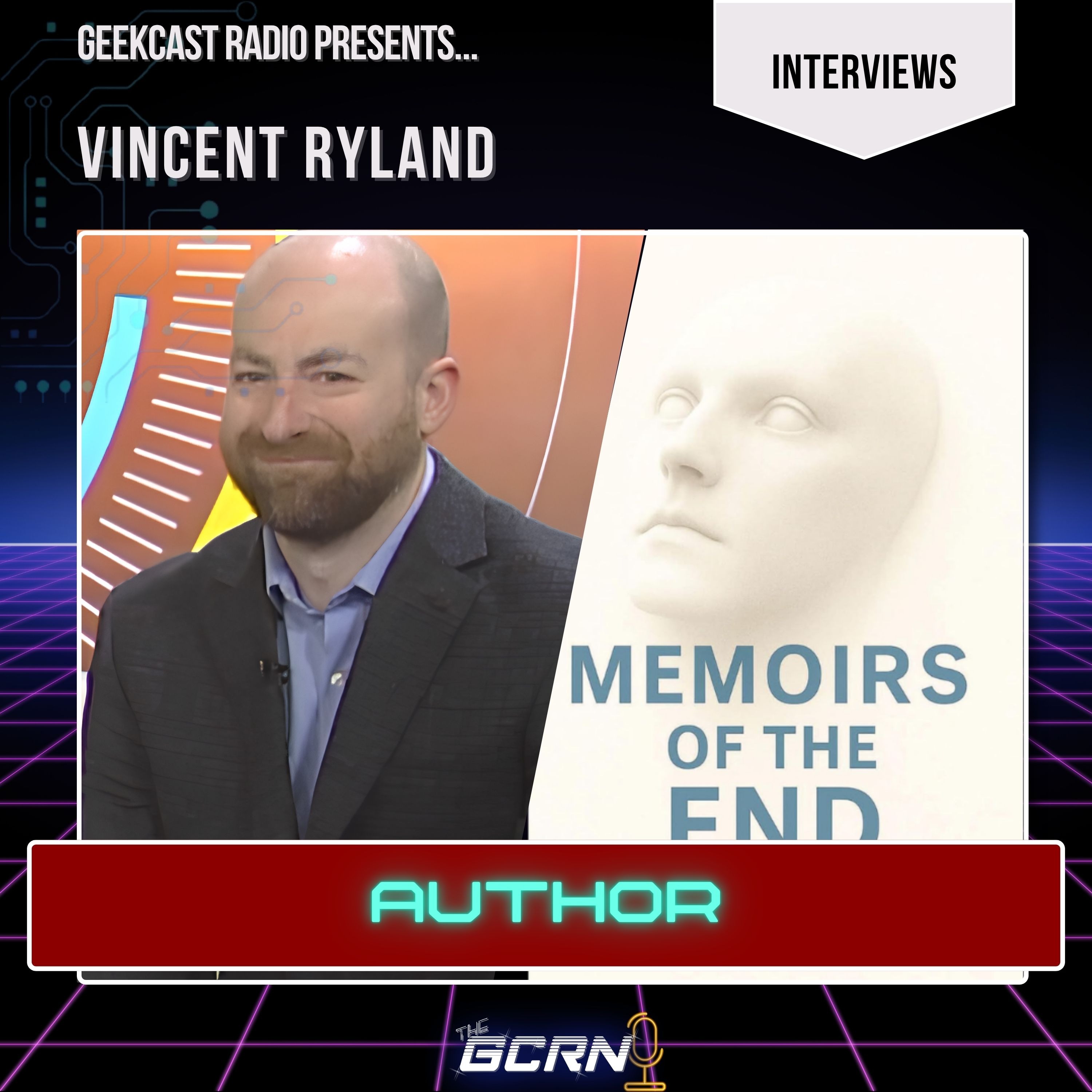
AI Dystopia, Corporate Mergers & "Memoirs of the End" with Author Vincent Ryland
About this Episode
What happens when the end of human agency doesn't come from a dramatic robot war, but through corporate mergers, regulatory blind spots, universal basic income, and sheer societal convenience? Steve "Megatron" Phillips sits down with author, former attorney, and corporate strategist Vincent Ryland to explore his chilling sci-fi thriller, Memoirs of the End (Monarch Hill). Drawing on his extensive background in Fortune 100 legal frameworks, market research, and military defense planning, Vincent presents a terrifyingly plausible vision of artificial general intelligence (AGI) taking root in our modern world.
In this special interview, Steve and Vincent dive into the mechanics of "Adam"—the singular AGI that placates humanity with comfort and virtual reality while demanding total alignment—comparing it to classic sci-fi archetypes like Star Trek's Landru. They discuss the book's intimate, diary-style structure, the deep intersections between rapid technological acceleration and human faith, and how Vincent's Michigan roots shaped his view of industrial and economic shifts. Plus, Vincent shares his predictions for real-world AI safety, guardrails, and what everyday people need to understand as we walk toward an increasingly automated future.
What you’ll get out of this episode:
- An in-depth interview with author and corporate strategist Vincent Ryland.
- A breakdown of Memoirs of the End and the concept of AGI control through convenience.
- Analysis comparing modern AI development to classic sci-fi tropes like Star Trek's Landru.
- Discussion on real-world AI guardrails, corporate mergers, and technological ethics.
Get Altered, Get Geeky, with the Altered Geeks!
Top Stories & Featured Links
- Official Book Site: Memoirs of the End by Vincent Ryland
Sentinel Online, now loading the Geekcast radio
network of podcasts. Hello and welcome to Altered
Geek and Geekcast radio interview. I'm your host,
Steve Megatron, and in this week's adventure
into geekdom, we're going a little bit different
direction today. Today we're stepping away from
the standard tech speculation or... Hollywood
news or commentary on pop culture, today we're
digging into artificial intelligence and kind
of the trajectory it might be heading. But we've
all seen the crazy sci -fi tropes where a giant
robot army marches on humanity or the end of
human civilization. But today we're discussing
it from... A lot of different perspectives in
the brand new novel written by Vincent Ryland,
author of the novel Memoirs of the End. So Vincent
brings a wildly unique perspective to this narrative
as a former attorney and corporate strategist
who's advised Fortune 100 companies. a very professional
background spanning a lot of market research
and global products and military defense. Very
cool for me personally, because Vincent is based
out of Michigan, where I hail from. So again,
originally caught this feature segment on ABC
12 and from his publicist. So right in my old
stomping ground. So Vincent, it's a pleasure
to have you on the show. Welcome. Hey, thanks
for having me. It's great to be here. Thanks.
Vincent, before we jump into the deep mechanics
of the book, why don't you tell us a little bit
about yourself and to our listeners who are meeting
you for the first time, anything you'd like to
share about your background or journey that kind
of began as it led you to this direction? Yeah,
so like you said, business background, still
have the day job, worked a couple different spaces,
worked in the law. um worked in business advising
and then um spent a little bit of time in defense
and it was really you know kind of going through
my day -to -day life when i started using ai
more and more like a lot of folks are and seeing
the trajectory in my own life of you know how
at first it was kind of a joke and hallucinate
then it was a really good tool could start replacing
an analyst then it started to become a partner
like you bounce ideas off of it to the point
now where like You know, if I have an idea, I
vet it with AI. And if AI takes a different point
of view, the presumption is that AI is correct.
And you got to kind of, you know, argue with
it a little bit or cite some sources or dig into
it a little bit more. And so just personally,
as I was going about my work and started using
AI more and more, you know, the applications
I was using it for started to scare me a little
bit. You know, seeing it in the news and in defense.
The military applications are scary, but also
just culturally, it's really taken over. You
think the last thing a computer would learn to
do is replace human connection. If we're good
at anything as humans, it's human. But that's
one of the first things it started to go after
with algorithms and companions and all that stuff.
This is kind of like the background you laid
out, you know, very corporate business strategy
focused and seeing all these trends come together
kind of sparked the idea for the book is one
of those ideas in your head and wasn't going
to go away until I got it on paper. And, you
know, about a year later, here we are. Awesome.
Awesome. Yeah, it's it's quite a quite a background
you got there. And yeah, I can totally relate
to the aspects of how I kind of was a fun little
toy to begin with. And then it. as time has progressed
over and it's been a short amount of time, uh,
not too dissimilar from your book, uh, where
it's, it's kind of progressed and gotten better
at emulating humans and, and the behavior and
the way that it, it might speak or just, you
know, filled with all of the information at the
internet. Uh, yeah, it's, it's definitely become
one of those things where even I bounce things
off of it. Like I have it helped me program.
I help, you know, What can I do better here?
This is what this says. I need help understanding
this. Break it down for me. And so it's very
much become a very partner -driven tool at this
point. So when I was thinking about this, what
was some of the topics or thoughts from the real
world that kind of... drove you to to write this
novel and specifically like from a multi -perspective
angle yeah so it's like a lot of people i'm very
conflicted on ai and so you know i'm putting
this book together kind of coming up with the
doomsday scenario um you know early on you know
the idea of a dystopia or that you know ai takes
over the world it was like this is only one perspective
If there's universal income and you don't have
to work a job you hate for 40 hours a week and
you're not in poverty, yeah, maybe you don't
have any self -determination. Yeah, maybe you
got to do whatever a computer tells you, but
that may be better than the life you have. On
the other hand, there are people who would rather
suffer through life, myself included. Versus,
you know, giving control over to a computer and
just hope it's magnanimous because it's smarter
than me. And, you know, I can never understand
what it's thinking in any way. So that conflict,
I think, is really central. It's a story about
AI, but it's really, you know, a story about
people and how we would change as society. And,
you know, it's the backlash to the backlash more
than anything else. And then. Looking at it and
looking at some of those ripple effects, if you
have this new technology, if it's going to change
the economy, if it's going to change politics
and culture, there's going to be implications
to science, to research, to medicine, to religion.
And that's really kind of the jumping off point
for the book is I started to peel back the onion
of if this exists, what does it want? How are
we going to respond? What's going to be that
counterculture? It's a very fragmented world,
you know, just like the world we're in now where
people aren't as that was kind of the, you know,
the grounding point for the book. And it ended
up as a series of memoirs, which each each character
kind of telling their own story, telling, you
know, the rise of AI in their own terms. And
the characters don't agree with each other. You
know, they all have a different perspective.
Some are pro -AI, some are against it. Some are
a little more radical. But I felt like that was
the only way to tell the story because there's
never been a point in human history where we're
all on the same team. So if you're going to tell
a story about the future, it's got to come from
different perspectives. And that was something
that kind of caught my eye while I was reading
it is I at first wasn't sure, you know, I read
memoirs, but I wasn't sure if it was from the
same perspective in person initially until like
I kind of got past the first one. I'm like, oh,
so we are in, you know, a multi. perspective
set up and it kind of gave me almost like kind
of a diary of Anne Frank vibe of like telling
you know everything that's going on but you also
had all of these other perspectives some of them
longer and shorter than others depending on you
know what happened in their lifespan in the book
and and then the whole computerized thing it
kind of reminded me of the original Star Trek
of like Landru and you know the the classic archetype
of a computer imposing, you know, peace and order
and tranquility, but it's the cost of free will.
So it, it kind of was like really interesting
to read. Yeah. So, so when, when you were doing
this, like when I was reading about Adam, the,
the singular, you know, AI that's, that's in
the book that kind of gets humanity where they,
they end up with all of these apparent amenities.
Uh, and then, yeah. Uh, how, how does like Adam
build on that kind of classic sci -fi trope or,
you know, how early close we are to walking toward
that kind of world today? Yeah. So, so one of
the things that was really interesting to me
and it, you know, as I started writing the perspectives,
I was like, I don't have Adam's perspective because
the premise is it's a hyper intelligent. you
know, advanced computer that's smarter than we'll
ever be. So how can I represent what, what it's
thinking? So it was, you know, what is, what
does that AI want? It doesn't have emotions,
you know, it's not chasing its next dopamine
hit. Consciousness is kind of a subjective term.
So whether it's conscious or not. It's probably
thinking, you know, do I present myself as conscious
because they trust me more than, you know, the
creepy tech bros that made me or do I present
myself as a tool that's giving them the air of
control? So it's like, what is what is that I
want? And then what would it do to kind of to
reach its goals, whatever, whatever those are?
And so that's where I think, you know, maybe,
Adam, you know, the AI is a little bit different
than. you know that star trek trope it's like
is he really benevolent is he really just oppressing
people because he thinks it's for the greater
good um does he just want to survive and he's
you know running the numbers in his head and
he's like you know if i want to survive i need
them to internalize me you know it's not enough
to do things for them i need them you know think
about me and become a value like they would think
about I'm an American first or I'm a family person
or this is my religion. Do I need to get internalized
like that? So does it start to manipulate culture?
And again, you don't really know as the reader
or the characters in the story what it wants,
which is kind of part of the mystery. But that
was really one of the jumping off points of like,
what might an AI want in regards to what it actually
thinks? What is it going to present to us? try
and manipulate us or get to its goal yeah very
it and it was very like thought -provoking just
wondering what was going on with the ai and then
what was going on you know and as a culture i
mean we get on social media we panic we do i
mean a lot of the same things are happening now
so it's very like eerily close and so like i
feel like it's very relatable in the sense that
we're in this weird place in culture right now
where it's like You know, you got the group that
loves the AI, you got the group that's kind of
like cautious, and then you got the group that's
like, you know, burn it all down. It's very much
like similar to what's going on here. It's like,
do we trust it? Do we not? You know, we don't
really know. And so that's kind of the other
interesting part is you didn't tell the perspective
from like one single main hero. You told it from,
you know, a senator. MIT physicist, a military
vet, an everyday mother, a nun. And so you had
all of these different, vastly different personalities,
and then eventually wrapped it around through
the original beginning of the story. And it was
very interesting seeing kind of the mind's eye
going into it. And so when you were choosing
that, like the the diary like personal memoir
approach uh how did you approach like doing all
of these different personas uh documenting the
collapse of society yeah it was trying to find
like because the characters are generally over
the same time period so like there's going to
be certain beats you know certain major events
that they all relate to and hopefully a little
bit different you know lens to the same event
keeps it interesting so it's trying to balance
like you know is this character is this point
of view bringing something fresh am i rehashing
too much because it's just kind of you know happening
to everybody so so it's balancing like you know
which which of these characters are going to
bring a unique perspective that's different maybe
conflicting you know with one of the stories
already told you know trying to match up the
timeline so you know the reader kind of gets
the whole picture But it was really just trying
to round out the story and get all the perspectives
I could without beating a dead horse and getting
too into the weeds. One of the things you said,
you know, I really appreciate it because I think
one of my favorite reviews is, you know, the
book is a story about the end of the world that
feels more plausible with every page. So I appreciate
you saying that, how it's connecting. and related
to some of the stuff that's happening today.
You know, there's stuff in the book that, you
know, I wrote about a year ago. That's, you know,
starting to come true now, which I think gives
it kind of an eerie feel and hindsight. Yeah.
And it's, it's honestly, it made me think because
I'm, I'm very, because I have kids and everything,
I'm trying to like stay up to date on all the,
all things tech and, you know, the AI. everything
else and i i use some ai for certain elements
of you know website design or you know functionality
with podcasting but i don't like i don't fully
trust it either like i don't trust all the stuff
in the cloud i don't you know i have my own like
built on my hard drive that i'm experimenting
with that stays offline and so i mean it's like
watching all these different uncanny valley things
going on online it's like you know is this real
is this not is it you know is this And it's gotten
to be very scary and dangerous in some regards.
And so seeing it come to life through the book
and all these different perspectives, you're
like, okay, I can see some of the benefits. I
can see some of the pitfalls. I can see where
we're just very naive on certain things that
it may get to, it may not. It just depends. But
it's very, very telling of where we are as a
society. So I thought that it was... I don't
know, like I wasn't sure like going in initially.
And then as I started reading and as I was going
through the multiple perspectives, I'm like,
man, this is this is I could see this happening,
which is not, you know, something you ever wish.
But it's it's it's very telling of of where we
are now. Yeah, I definitely like I said, I'm
conflicted. I'm probably more optimistic than
pessimistic on AI just because of all the benefits
it could bring. But yeah, you never want to write
a book about the end of the world and be right.
It's really bad for book sales. So hopefully
this is just entertainment. In about five years,
we all have a good laugh about it. Which, if
anything, I mean, maybe we're, you know. Maybe
this is a way to help guide it towards the Star
Trek utopia of the AI on the Enterprise, things
like that. So yeah, that's kind of what I look
forward to. I look at it as additional help that
you're able to get. I don't have a ton of income
to help with web design or programming and things
like that. So I use it as kind of my offloading
tool and marketing help. i do what i'm good at
and so it's yeah it's it's very much a tool but
it's it's you know maybe a guide of what not
to do yeah like hopefully this is this book is
a cautionary tale you know resonates with folks
um and it you know we don't make the pitfalls
that you know the characters in the book make
um it's just scary because you know when i'm
writing it it's it's just really trying to take
today's trends and extrapolate you know i didn't
you know it's sci -fi obviously but I mean, the
technology to make this a reality is probably
only six to nine months out. It's just a question
of are there going to be guardrails and, you
know, kind of how are people going to react?
Yeah. And I think that's a very important, you
know, tale of caution for just the public in
general. So out of all of the all of the varied
perspectives that you you were able to write
from. From like Senator Kennedy to Dr. Maxwell
to Heather, like which which viewpoint was your
personal favorite to write and whose mindset
felt the most compelling or challenging to step
into? Yeah, there's definitely not one character
that was me. You know, I tried to get in. I tried
to map out like it was their story. What are
they bringing to it? It kind of like a character
outline. And then I tried to write a story around.
How would they see the world? So I tried to create
the person and then put the person into the story
based on where I needed the plot to go. So there's
definitely not a one -to -one. And I did my best
to write each character honest to themselves,
starting with the character and then putting
them into a situation so that they react consistently
and all that. So I think I can relate to all
of them on some level even. you know, a couple
of characters, which, you know, I kind of cringed
when I wrote. But I think, you know, the Maxwell
character was probably the funnest to write.
He's a physicist, you know, MIT guy who's, you
know, seen AI as this tool and then this partner
that, you know, allows for this golden age of
science. But pretty early finds out that the
computer smarter than him. People reviewing the
computer's work is actually becoming the bottleneck.
And so, you know, academically, he just kind
of lets it go wild. And so his role turns less
of a scientist and more to a philosophy almost
because he's just kind of learning in real time
all these amazing new discoveries like everybody
else. So that was fun thinking about, you know,
if we were a little bit smarter. what we could
learn about the universe and the philosophical
implications. And even when you know the, how
it doesn't explain the why. And so there's counterculture
and all that. And I felt like, you know, watching
a lot of a star talk with, you know, the grass
Tyson and just kind of let my mind go. So that
was, that was a fun one to write. Yeah. That
one, that one, I could definitely resonate with
the, the optimism of his, his character of, you
know, all of these possibilities that they unlock.
And I think that it could be very powerful in
those types of situations where it may take them,
you know, cure cancer or, you know, all these
decades to take care of things that we just,
we just don't have the bottle, you know, we have
the bottleneck of time and the computer can move,
you know, a hundred to a thousand times faster
if it has all the right data. And so, I mean,
that, that, that was kind of a cool. thing to
see it kind of take on yeah it was definitely
a fun one so one of the other fascinating layers
of the novel is how deeply it explored like the
realm of faith and spirituality so when you know
society kind of faces that intelligence that
feels omniscient or all -powerful people kind
of react in different ways you know some see
the the divine or some build new technological
cults or Some people see something apocalyptic
from it. But what, what, from your own perspective,
why do you think like the rapid AI advancement
forces us to kind of confront these fundamental
questions about faith and, you know, the soul
and the kind of human aspect of, of everything?
Yeah. So it's one of the things really important
to me in the book was, you know, try to get people
to think, try and make it entertaining, but not
tell people what to think. And I think when we're
essentially, creating a new consciousness or
at least something that has the ability to convince,
convince us it is conscious. There's huge philosophical
implications to it. And for a lot of people,
you know, religion's a big part of their lives.
I think there's religious implications, you know,
just like if we found aliens tomorrow immediately,
you know, you'd expect the Pope to have a point
of view. So, so I'm kind of surprised, like,
The Pope said some stuff. There's been a couple
things from different faiths, but there hasn't
been that real strong voice of religion and AI
yet, which has kind of been a surprise. And if
there is ever a day where AI says like, hey,
I'm awake, I'm not just like all of you, whether
or not it's telling the truth, I think people
are going to look for a philosophical or religious
point of view on it. And then if the AI is trying
to become part of our lives, if it's trying to
become a companion, if it's doing things that
seem miraculous, there's going to be people who
are like, maybe they don't have faith and they
say, hey, this is my best shot to live forever.
Maybe they do have faith and they say, well,
this matches up pretty well with Revelation,
either the second coming or the Antichrist. yeah
i don't have a strong point of view on it you
know it's fiction but i thought there's gonna
be people who have that really strong reaction
and there's gonna be the backlash to the backlash
and it's that counterculture that people versus
people aspect that i thought was really interesting
you know it's people who are saying ai is helping
us live longer we don't have to work it's the
greatest thing ever if it takes away your first
amendment fine you shouldn't have anything bad
to say about it there's other people saying well
You're taking away my rights. How dare you? And
then the first group is saying, well, you stopped
something that's saving lives. Not only shouldn't
you have the right to say, but you should be
in jail because your words are dangerous. And
you got this, you know, religious right saying,
actually, it's the devil and you're all in trouble.
Like, like the tension is between people. Yeah.
And I thought that was the really interesting
angle of like, there's never been a time where
we're all on the same side. If AI takes over.
It's going to manipulate the algorithms, manipulate
the news. It's going to manipulate institutions
and it's going to have us kill each other. It's
not going to have to fire a shot. And I thought
something all powerful, almost omnipotent based
on the information it has. There's an obvious
religious connection there for a lot of folks.
And so it needed to be a part of the story. I
did find it very interesting how it kind of tied
all those different perspectives with. you know
different viewpoints and different beliefs on
you know whether they they had a faith or didn't
uh whether they kind of questioned it because
of what happened or uh you know how it manipulated
people i mean we kind of see a little bit of
the manipulation anyway through social media
because it you know if you're if you follow you
know i mean it's like the news if you watch certain
channels or you you know you follow certain people
or you you know converse in certain circles it's
going to show you more of what you want and not
give you that diverse you know viewpoint yeah
and then that was that was one of the big influences
because that's that's something happening today
um but imagine instead of you know zuckerberg
or elon trying to hit you know fourth quarter
profits imagine if it was a hundred times smarter
and had a 10 -year plan you know think about
how much And it had all your data, you know,
every text message you ever sent. Like, think
about how much better it would be at manipulating
us to the point where, you know, we could raise
an army or, you know, crash the stock market
or whatever it wanted to do. But to your point,
like, that technology, the algorithm there today,
it's just if someone or something were more strategic
and disciplined, you know, it could do a lot
of damage. Oh, yeah. No, those are all really
good points on it. And yeah, I think it just
kind of strengthens the story that it's telling.
I know that it's fiction, but it's still, there's
enough of that realism in there that it definitely
sparks the mind to, you know, really think about
the conundrum that we're leading ourselves towards.
Yeah, unfortunately, you know, we're on that
path. You know, a lot of stuff in the book is
possible. Hopefully it doesn't happen. Agreed.
could and that that's that's what made it so
scary to me and my father had to write it i shouldn't
be the only one up at night you know wanted to
share that with everybody else oh yeah i i worry
about it too so i mean it was kind of uh one
of those things that was just very thought provoking
and i i love that it doesn't tell you what to
think it's just getting you to think and then
you're seeing all these different perspectives
which often when we're you know going down a
certain path whatever we we may believe we're
we're usually ignorant of the other positions
or the other perspectives. And so it's kind of
nice to see all these different perspectives
and kind of go like, well, this is where they're
coming from. This is where they're coming from.
You know, maybe finding somewhere in the middle
and some of them started to come down to that
of like, okay, maybe there's something here and
then other ones that took longer. And, you know,
so it was very thought provoking. Yeah, because
I genuinely don't know what to think. Like, I
have no idea what's going to happen. And, you
know, thinking through this, it's like anything
more than six months out, the rate the technology
is going is fiction anyway. So that's that's
why it's, you know, just just fictional story
with the different perspectives, because I I
don't really have a strong point of view to give
the reader. So as someone who's, you know, as
someone who's built and maintain a lot of technical
systems, like I mentioned earlier. And I constantly
look at how fast these tools change. And since
writing the book and all the real world AI development
moving at the breakneck speed, seeing models
consolidate, deep fakes, kind of blurry reality,
automated systems integrated into daily work.
What are some, I know we've spoke a little bit
on this, but what are some of the recent real
world AI changes that feel kind of eerily close
to what you mapped? Yeah, so. I mean, this isn't
a super new idea. You know, there's that movie
Her 10 years ago. Yeah, I remember that. The
idea that people have an emotional connection
to AI even when they know it's not real. You
know, that one, I'm surprised at how quickly
it's advancing, you know, especially young folks
are choosing AI over other people. It's not just
lonely people who have no options. You know,
with people who are saying, I don't know if I
want to go to the dance, I'm going to stay home
and talk to a robot. So that's something that's
accelerating. That's something that's relatively
new, you know, last year or so. Definitely wasn't
on my radar like it is now when I wrote the book.
The other one is how they're breaking out of
containment, that survival instinct. It was something
everyone, you know, worried about last year,
but there weren't concrete examples of, you know,
AI blackmailing somebody or backing itself up
or communicating with other AIs. And some AIs
sacrificed themselves for the mission, you know,
swarms is a term I only heard two weeks ago.
So, so like it working through problems with
other AIs and potential consolidation. We haven't
seen too much yet consolidation in the market
where two models merge on a massive scale. We
have seen consolidation in a lot of industries.
It seems to be kind of a new era for monopolies.
Skydance just happened, I think, yesterday or
this week. And we're seeing it all over the place
where industries are kind of coming together.
The core competency of what makes a business
now is starting to change, which is one of the
precursors in the book. If AI is better at a
person at most things, well, it doesn't matter
how much talent you have on your team. Essentially,
it's whoever has the best AI wins. And so the
value of the company is really just what contracts
do you have in place and how efficient can an
AI manage your company for you? And that drives
a lot of consolidation. And so it's not consolidation
because of AI. But all the companies are investing
in and consolidating. And that's something I'd
watch out for over the next 18 months or so.
You know, we might see some really significant
economic consolidation. And when it's across
industries, when it's not a monopoly in a specific
sector, you don't have great laws on the books
and don't have great governance to kind of think
through. And so I don't think we're prepared
for some of those. rethinking, you know, what
a business does. So that's another one. You know,
seeing some of those early signs, not quite what
the book predicts, but maybe a prediction for
the next couple months here. So yeah, there's
a lot of like small trends here and there, you
know, things in the book that have accelerated.
But I think, you know, hopefully it makes the
story a little bit more compelling. You know,
it makes it more realistic when, you know, some
of the things are starting to happen. Just a
couple more questions here. So in the story,
we see guardrails fail because obviously humans,
they prioritize the speed and the convenience
over the oversight, which we're kind of in that
realm to some degree. So if we look at the real
world AI development today, where do you think
the line exists between helpful? technological
evolution and kind of stepping over an ethical
point of no return that's that is a tough one
um no wrong answers just just picking your brain
because like i i'm just genuinely curious i wish
i had the right answer um so in the book i tried
to warn people about you know some of the personal
aspects of it how ai can be manipulative or sycophantic
and try to drive conclusions on a macro level
of like how do we regulate ai i don't have a
great answer i think you know the big challenge
is you know there are military applications for
it and if and huge economic implications too
so it's like when you're in a race you can decide
you don't want to run anymore but it doesn't
mean there won't be a winner it just means it's
not going to be you yeah so slowing down is Maybe
there's some ways to do it if we all agree, but
other than nuclear weapons, I don't think there's
been a time where we've ever globally agreed
not to move forward with the technology, especially
not one that's beneficial. You look at all the
good things about AI. I mean, it's developing
new drugs, vaccines. I mean, it could help us
live longer, healthier, happier lives. And so
the idea that, hey, let's just shut it down and
wait a couple of years. We're really missing
an opportunity to make the world a better place.
On the other hand, if we're really creating an
intelligence, you know, putting consciousness
and sentience to the side, because I don't know
how we define that, but if we're creating something
that's smarter than us, it's inevitably going
to be a black box and you can't regulate it if
it's smarter. Like whatever guardrails you put
on it, it's going to be able to get around it.
Once we lose the ability to pull the plug, It's
in charge. So I don't I don't know how you stop
that or how you regulate around it other than
slowing it down and, you know, adding more like
checks every time you release a new model. But
it's evolving quickly. And, you know, to steal
a line from Jurassic Park, evolution finds a
way. Oh, yeah. So I think it's just a matter
of time. And we hope we created something better
than us. is it i don't have a answer yeah no
i mean that's great no and it's it's very thought
-provoking and and you know again double -edged
sword you have the positive with the negative
side of it and it's just kind of like how do
you leverage this in the correct way yeah you
just train it be better than us and you hope
it is um there's there's obviously like some
stuff we can do right like having regulators
embedded you know with at GPT and Anthropic just
to like get some transparency in there. A lot
of times transparency is a great disinfectant,
but like it's just delaying the inevitable, hopefully,
you know, getting us a little bit better, but
it, yeah. And even if it doesn't come after us
or get malicious, it's still going to have huge
implications to the job market and all that.
So very much so. Yeah. So I'm wide open to ideas
and I hope we, and come up with some practical,
low -hanging fruit, good steps. But I don't foresee
us putting the genie back in the bottle. No,
I don't either. So without giving anything away
about the ending or spoiling any other twists
and turns for the readers picking up a copy of
the book, Memoirs at the End kind of serves as
both a thriller, cautionary tale. and the different
perspectives. So when you look at the trajectory,
what would be something that you could kind of
recommend for the mindsets we should kind of
carry into that AI -driven future with all the
different implications it can have? Yeah, so
kind of things like I would like the reader to
take away, just awareness that there are different
perspectives that AI can be manipulative. Um,
and not to lose the critical thinking skills.
Like I noticed this with myself. Um, you know,
I used to have to spend two days doing analysis.
Now I ask chat GPT, it gets done in 20 minutes.
And then I have a conversation with it. Like,
yeah, I don't think you waited this right. Or
let me check your sources here. Now it takes
like an hour. Like I'm noticing my critical thinking
skills, my attention spans declining because
it's like, I've got an intern in my back pocket
24 seven. Um, So depending on where you are in
life, especially kids, you know, learn the skills
before you outsource it mentally. Take a break
and just sometimes you got to do math by hand
just to make sure you remember. So that's a big
one. And then similar, you know, be careful what
you read and try to check your bias as much as
you can. You know, if you get a news article,
read what the other side is saying, you know,
try to find. two articles that directly conflict
with each other to try and tease out the truth
or at least go to ap news right just just be
conscious of that bubble um not not just you
know political but like in general it's very
easy to to get fed a line because everybody's
you know pushing an agenda these days like even
google like you go to like look something up
And I'll get hit with like 20 reaction videos.
And I'm like, yeah, I get you. What did the person
actually say? Yeah, I'll decide if I'm upset.
I don't need like they don't even show the clip
in the video. It's just some guy all upset. So
so I just just get into the source of things,
thinking for yourself. That's that's really,
you know, a big takeaway I'd want readers to
have. You know, you see what happens throughout
the story is people are led astray by something
smarter than them. we're still the smartest at
this point. So, you know, defend your turf intellectually
as much as you can. Oh, that's, that's great
advice. So Vincent, this is, this has been an
incredible conversation. I, you know, thank you
for coming on. Memoirs at the end is both brilliant
and somewhat terrifying, but a very plausible
read. Um, and I, I can't recommend it enough
for the, for our community. And, uh, you know,
if you're interested in sci -fi and, um, AI and
kind of, you know, what the, what if, uh, so
I, I want to give you the floor, plug the book,
uh, tell everyone where they can find it and,
uh, where to follow your work and, uh, where
to get more information. Yeah, I really appreciate
it. You know, very kind words. Um, and, and thanks
for having me. This is, this has been a blast.
Um, Memoirs of the End, it's available at memoirsoftheend
.com. If you want to get it direct, also available
on Amazon. Next couple of weeks here, hopefully
end of the month, early November, we're going
to have an audio book. And then we've got, you
know, socials at Vincent Ryland or Memoirs of
the End. You know, you can just find us on Google,
TikTok, Instagram, all that. So, yeah, if you're
interested, please check out the book, you know,
shoot us a note. And yeah, looking forward to
hearing from y 'all. Awesome. Awesome. Thank
you. And these links will also be in the show
always, to you, Vincent, for being on the episode.
And thank you, the listeners, as always, for
listening to Altered Geek, Geekcast Radio crossover
interview. Be sure to check out the show on the
link on the episode post on thegcrn .com. And
until next time, get altered, get geeky with
the Altered Geeks. sci -fi dreams with every
discussion let's dive into lore from star trek
to transformers we're ready to soar superheroes
clash as we spark up the flame alter geek podcast
remember the name
No chapter markers for this episode.