For about fifteen years, creative software went from something you bought to something you rent. Stop paying the $60-plus a month and your project files get held hostage. The excuse was always the same: building this stuff takes an army of engineers, a decade, and a few hundred million dollars.
I’ve been watching that excuse get tested in real time, and I’m not talking about it secondhand. I have eight of the thirteen ArtCraft apps installed on my own Windows machine.
What ArtCraft Is Putting Out
A team called ArtCraft (getartcraft.com) is releasing open-source replacements for the usual suspects, one category at a time. Here’s what’s in the suite right now:
| App | Alternative To | Version |
|---|---|---|
| VectorCraft | Illustrator | 0.21.0 |
| EffectCraft | After Effects | 0.21.0 |
| PhotoCraft | Photoshop | 0.20.1 |
| FilmCraft | Premiere | 0.17.0 |
| PdfCraft | Acrobat | 0.18.0 |
| LightCraft | Lightroom | 0.18.0 |
| DesignCraft | InDesign | 0.8.0 |
| WordCraft | Word | 0.15.0 |
| GridCraft | Excel | 0.16.0 |
| DeckCraft | PowerPoint | 0.15.0 |
| SoundCraft | Pro Tools | 0.17.0 |
| CADCraft | AutoCAD | 0.17.0 |
| TextureCraft | 3D Texture Painting | 0.3.0 |
| MaterialCraft | Procedural Material Design | 0.1.0 |
| Craft Anything | Reverse Engineer Anything | 0.3.0 |
| SolidCraft | 3D CAD | 0.30.1 |
| FigCraft | Figma | 0.15.0 |
There’s more being added all the time with daily updates.
All of it is free and open source, with no subscription. You don’t need to log in just to launch an app, and everything runs locally on your own machine. And it’s FAST!
The Launcher
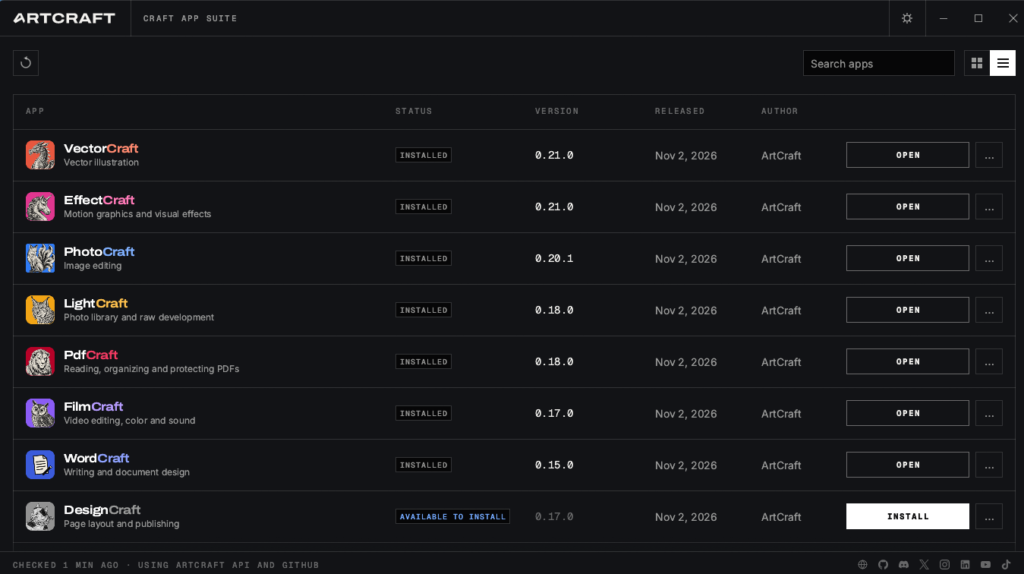
ArtCraft ships a single launcher that manages the whole suite. It lists every app with its installed version, the latest version, and a release date, and it filters by installed, updates available, and not installed. You can flip between a grid and a table view, and each app gets a one-click Open or Install button. It checks GitHub for releases, and there’s a Discord link built right into the toolbar. It’s less like a pile of separate downloads and more like having your own app store for the suite.
Where the Versions Stand
Every app is still pre-1.0, sitting anywhere from 0.1.0 to 0.30.1. That’s beta software, and I’m not going to pretend otherwise. The latest builds in my launcher are dated November 3rd, 2026. If you’re thinking about moving a real workflow over, test with copies of your files first.
I’ve tried out the various ones that interested me since I’ve not found a suitable replacement for Premiere, Word, Excel, PowerPoint, Photoshop, Illustrator, Acrobat, and After Effects yet. They for some odd reason decided for Pro Tools instead of Audition but I’ll get to that later. Compared to the originals, most feel almost 1:1 without the bloat, AI integrations, forced logins, forced cloud sync, etc. FilmCraft aka Premiere is still getting there as is Illustrator’s VectorCraft.
Why Native Rust Matters
A lot of modern desktop software is really a web page in a wrapper. These apps are written natively in Rust with direct GPU acceleration through Metal and Vulkan. Compare that with the Electron-style apps that can chew through 8 GB of RAM to show you a dropdown menu. Native code means faster launches and lighter resource use. It also means the apps can talk to local AI models through open APIs, without sending your work to someone else’s servers.
The Linux Factor
This is the part I keep coming back to. For years, the biggest wall between creators and Linux was software availability. You couldn’t run Adobe or Microsoft’s suites there without virtual machines or translation layers that never quite worked. Because these apps are built natively, they run on Windows, macOS, and Linux. For a lot of power users, that removes the main reason they never switched. For others, some have made mobile and web capabilities to these projects a reality.
A Community That’s Already Huge
ArtCraft’s Discord is well over 120,000 members now. People are submitting feature requests, filing bug tickets, and naming the subscriptions they want turned into something they can own. One request comes up a lot: an Adobe Audition alternative. I’m in the group, and plenty of people want one, but nobody was stepping up to build it. Development of the existing apps is driven by a growing team of volunteers on GitHub, with the community feeding it direction.
About That “Clean-Room” Label
I want to be upfront about this term. Traditional clean-room engineering means one team studies the original product and writes a spec, and a separate team that never saw the original builds from that spec. What ArtCraft describes is different. AI is used to study how the software behaves, looking at inputs, outputs, and edge cases, without decompiling or touching the proprietary code, which would be illegal.
Whether that approach holds up legally is a gray area, and EULAs often restrict reverse engineering of any kind. So I’d call it behavior-based rather than clean-room in the strict sense, and I’d expect the legal questions to get tested. I’d rather say that plainly than pretend the label settles it as others do.
Where the AI Actually Fits
This isn’t vibe coded. Humans maintain the Rust codebase on GitHub. What’s AI-driven is the grind work: thousands upon thousands of hours of testing, edge-case analysis, and scenario simulation, the kind of coverage a small volunteer team could never afford to do by hand. It’s AI as a testing partner, with people still deciding what ships and what doesn’t.
The Honest Downsides
Software that’s generated and iterated this quickly carries real security risk. Nobody knows everything that’s in it yet. Dependency chains need constant review, and the community has to keep auditing and sandboxing as the projects grow. If you’re going to run young software, treat it that way.
The incumbents aren’t clean either. Telemetry and diagnostic collection have been written into their terms for years. Over the last five years, AI features were pushed on users, and in some cases data was used for training with no opt-out, or one that was very hard to find. With open-source, local-first software, you can at least see what’s running on your machine and if needed, fix the leaks.
The Audacity Lesson
Open source isn’t automatically safe, either. Audacity was the go-to lightweight editor for podcasters and creators for two decades. Then Muse Group acquired it, telemetry followed, and the community had to fork it into builds like Tenacity just to strip it back out. Who owns and steers a project matters even when the code is free. It’s worth watching how ArtCraft handles governance as it grows especially with their own license choices.
Why I Care
This is the same approach I took with my WordPress plugins. When the commercial options got too bloated, restrictive, telemetry focused, or paywalled, I built my own to run podcasting and publishing for The GCRN. Nobody had to hand me permission, and I didn’t have to rent anything. I was fed up and I made it happen.
Now I’m doing the same on the desktop. ArtCraft has SoundCraft covering the Pro Tools side, and I’ve got it installed. But when I watch the community, people keep asking for Audition, and nobody was developing it. So I am. It’s called Altered Audio Editor, a free, open-source, Audition-like alternative customized for podcasters, with clean, fast, local audio editing and no monthly rent. See here: https://github.com/geekcastradio/altered-audio-editor
The difference today is that an indie creator or small business who knows what they want can get it built without paying a big company to do it, or spending years learning to code first.