The Comic Concierge
Interview with Mark Russell on Writing for Comics
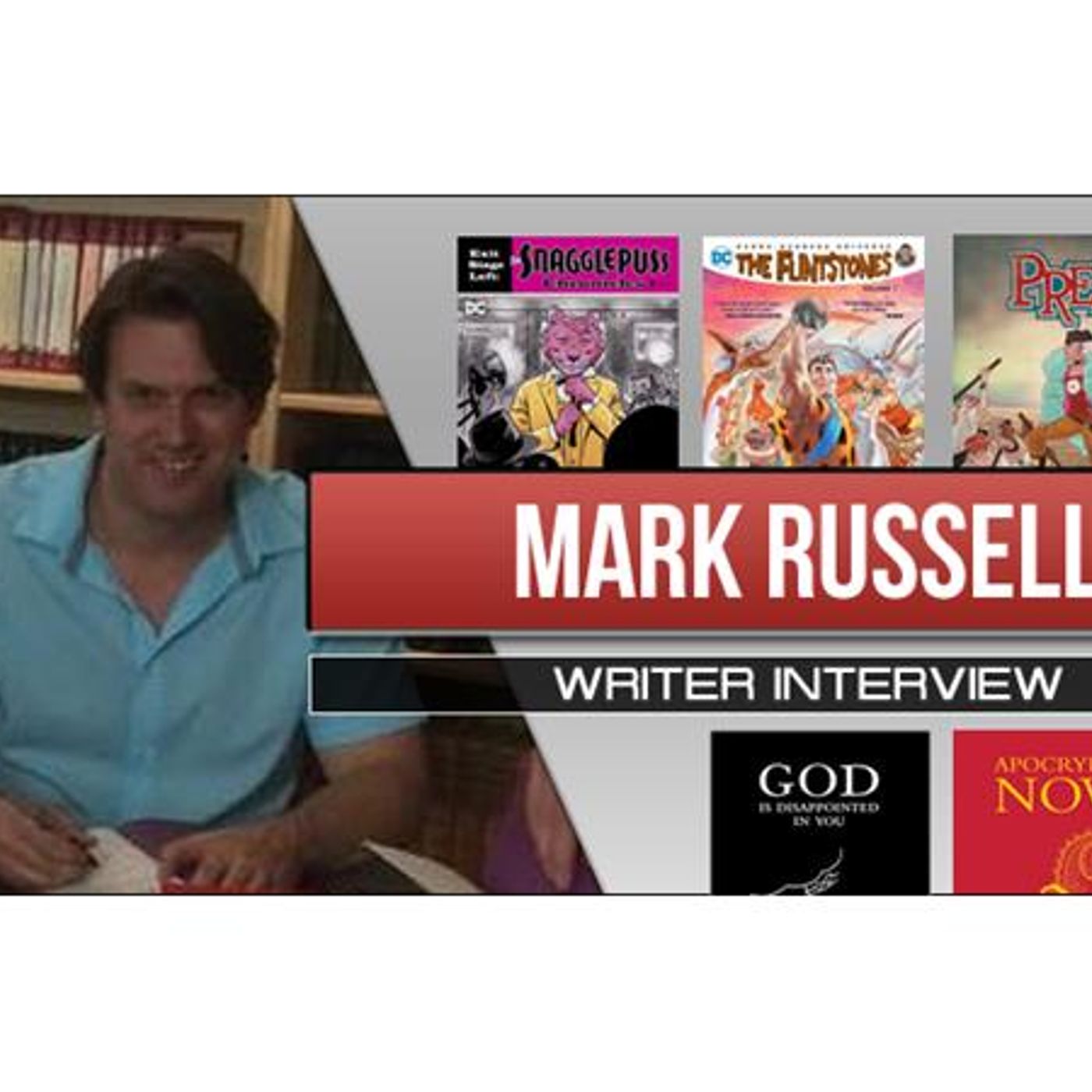
About this Episode
Welcome to the Comic Con Sears podcast, the podcast
that believes that comics are for everyone. The
key is finding the right one. Today, I am very
honored to have a very special guest with me
today. He is the writer of many fantastic comic
book series, including Existage Lefts, The Snagglepost
Chronicles, The Flintstones, and upcoming Judge
Dredd series, including the novels as well as
God's Didn't Point at You and Apoc for Now. Mark
Russell, thank you so much for joining me today.
Thanks for having me. I appreciate you taking
the time. As I indicated, kind of the thesis
of this podcast is that comics are for everyone.
And with that, I tend to, when people come on,
get an idea of their background of comics in
the sense of their lack of background or what
got them into them. So I thought that'd be a
good place to start in the sense of, you know,
what is that got you into comics as a fan and
or as a writer? Yeah, well, as a writer, I'm
a pretty much a newcomer to comics. I didn't
really start writing comics until 2015. when
I started working on a series for DC called Prez
about a teenage girl who gets elected president.
That was the first comic I'd ever written. And
I have to admit, my background in comics as a
fan is pretty lacking compared to most comic
book creators. Most comic book creators eat,
live, and breathe comics. They've been reading
comics forever. They know the canon for at least
the... the big two. Uh, so I was, I was really
kind of not, I was not much of a comic book fan
growing up. I didn't read a lot of comic books
and I wasn't nearly as familiar with comic books
as most other creators when I started. So I had
to do a lot of catching up. And I mean, there
are a lot of comic book creators. I really love,
uh, I, I, you know, and always read, of course,
the big ones like Alan Moore and the Watchmen
and loved it. And I read a lot of Daniel Klaus,
who's still probably my favorite comic book creator.
But in terms of like the big two, I hadn't read
a lot. And I'm finding, though, that there's
a lot. I mean, this is not really a surprise
to anyone anymore. There's a lot of really wonderful
writing, like capital L literature in comics,
even in like the superhero franchises that you
normally wouldn't expect to find that sort of.
cutting or really insightful commentary on the
world around him. I've had a lot of catching
up to do as a creator, but at the same time,
I've really enjoyed it. Sometimes when somebody
tells me that they haven't seen a movie that
I love, I sort of envy them because they now
have the chance to watch a movie for the first
time that I've loved for years. I kind of feel
like that... that's me as a comic book creator
like i get to discover these things for the first
time which i didn't really grow up on and i i
hope that you know and i think my appreciation
is a lot fresher for these things and maybe somebody
who did just grow up consuming them yeah i think
i think that's a good point i think even you're
reading your comics i think there's a fresh voice
in there obviously especially with something
like the flinchstones or prez you obviously have
these franchises you're working with that have
a history but there's no I think reverential
treatment. It's very much. You're able to kind
of approach them in a new perspective. I think
it's really good when creators are not familiar,
super familiar with comics coming on board and
you get some really new and fresh voices into
the medium. Yeah, I agree. I think, yeah, I don't,
I don't really know enough to be reverential
and it's probably been an asset. Yeah. Since
I, I think these are the sort of comics I like
too. When I read them there. They're not the
comics that are just written by people who are
just sort of commenting on other comics or riffing
on other comics that they've read in the past.
I tend to like the ones that are people writing
about the real world, things they've experienced
or other interests they have outside of comics
and then using comics as a prism to translate
them into a story. But to me, that's what's meaningful,
using comics as a medium to talk about the outside
world, not just comics to sort of regurgitate
the formulas we've already seen a hundred times
before. Definitely. Is that typically your process
when you're kind of constructing your narratives,
where you have an idea of the message or the
themes that you're going for, and then you try
to figure out how to shape the narrative around
it? Or do you do more like an inside -out approach?
within your you creating a story you kind of
find out okay this is where i want to approach
this this story or this is the the themes i'm
going for just curious how you approach your
overall you know creative process yeah i um just
kind of do whatever works and sometimes either
or both of those sometimes there's something
very distinct i want to say there's some something
i want to say and so i come up with a sort of
parable yeah to say that that works in comic
book form and then other times I just have a
story, or even not even a story, just a moment.
As I start writing it, I start working inside
out, and then from there, I figure out at the
end what the story was actually about. I know
it's like... God's Disappointed in You and Apocrypha
Now, including the Flintstones, you're looking
at often where society is beginning, the early
stages, where we kind of went wrong to start
with. And then with Perez and I'm assuming the
upcoming Judge Dredge series, you're looking
at where we're going. When you're looking at
constructing kind of your parables, as you call
them, is that approach any different from looking
at two different perspectives in that way? Yeah,
it's a little different in that I have to...
I have to work within the franchise itself, the
strictures of the franchise. But it's the same
in that I tend to think of this as like, what
are the central problems of this world? What
is it in this world that people would be having
to deal with? And the Flintstones, because they're
creating civilization, they're making it up as
they go along, the problems they're going to
be encountering are basically those of gullibility.
or naivete, not understanding the implications
of coming up with television or live news or
electing leaders because they sound like they
kick ass. Unfortunately, at naivete, we don't
seem to have shed 30 ,000 years later. But yeah,
it's very different than talking about a civilization
that has already made those mistakes several
times and is just sort of dealing with the aftermath
of them. I think that a key point in writing
any sort of dystopia is that chances are the
people living in the dystopia don't realize they're
living in a dystopia. So to them, this is just
normal. This is just life. But to the reader
at home, they obviously realize how messed up
everyday life is for these people. So I try to
remember that when I'm writing a futuristic thing.
To make those characters almost blasé to the
sorts of things that horrify us that are going
on in their world. Whereas the Flintstones, everything
was brand new, so I tried to do it. The opposite,
where like everything kind of strikes them with
a sense of wonder and newness. Interesting. It's
like establishing a normalcy where the other
one, as you mentioned, the naivete of everything
new and fresh. Right. Try to make the horrifying
seem mundane. And then, you know, and also the
mundane seems spectacular. You wonder looking
at today's world if that's... all too common
if whoever's writing our story might be taking
the same approach. Yeah, right. I think we probably
are at one of these points in history where we're
some weird confluence of naivete and dystopian
resignation, largely because I don't think we've
come to terms with the implications of the new
information economy and social media and how
we're being... used by them how we are have become
the product not the users of of these things
and so in that sense we are like the Flintstones
but at the same time it feels very much like
it's it's devolving into a dystopia like Judge
Dredd very true it's very and with that you mentioned
like social media we are in a world where like
social political commentary is everywhere like
you can't kind of escape it and obviously you
know your books as you mentioned they have that
leaning and i think it's very effective i think
it's the way you approach it is sharp and especially
for a comic i think it shows how how well comics
can approach like the social commentary of today
for you what is like the the key to effective
social commentary is it the ability to convey
an interesting message or the ability to be kind
of see things from different perspectives like
Because we see a lot of it, and most of it doesn't
tend to be very good. I was just curious, what
do you think the differentiating factor is between
good social commentary and maybe heavy -handed
or missteps? I think a lot of it boils down to
simplicity. Like, how do you take a complicated
issue and reduce it down to one line or one point
that will hit the reader like a lightning bolt?
To me, that's always the challenge of good social
commentary is like how not to make your commentary
as convoluted as the topic often is itself. Do
you notice certain topics that it's easier to
do that with than others? Yeah, and I think it's
a lot easier to do it the less angry you are
about it. I mean, there's lots of things I write
about which disturb me and which I feel passionately
about. But I try not to write about them while
I'm feeling that way because it clouds my objectivity
and it multiplies the number of things I want
to say about it. I try to look at it. Even though
there are things that deeply disturb me or that
I feel very passionately about, I try to cool
off a little and then look at it like I would
if I were an anthropologist visiting from outer
space. Like if I had to explain in an elevator
to my boss on... you know, the planet Las Vegas,
what is wrong with the human race? How would
I do it? You know, and, and usually, you know,
just come up with a line or two. Yeah. I noticed
that reading, you know, God's disappointed in
you in the sense of where you were boiling down
in the entire Bible. And clearly there was jokes
being made and things of that nature, but there
was a lack of nastiness. As you, as you said,
there was a more of a matter of factness to it.
And it didn't seem like it's almost like when
you're. talking about a family member it's like
you you know them well enough to approach the
things most people don't but you also know there's
a line that you don't want to cross because then
you like you said you lose your object objectivity
notice that too and like the last issue of the
flinchstones the conversation that they have
about religion i thought that was a really key
piece did the work you did on those two series
that they often correlates with one another since
they kind of covered some similar topics Yeah,
and I mean they all kind of are ultimately mouthpieces
for my own sort of views on the world and who
we are as human beings. But yeah, that's very
much by design. I want to – even if I think something's
wacky, I want to at least understand why people
feel that way or why they believe in what they
do. And so that forces you into this sort of
role of – attempting to be objective and think,
well, how would I see it if I were them? Basically,
I guess objectivity is probably the wrong word.
What I really am striving for is a state of empathy.
Help me see the world through their eyes, even
if it's something that I really just do not understand
or like at all. Help me see the world through
the eyes of the people who do. And then I can
perhaps make a better point about... about them
and maybe even also something that is that is
sympathetic to to what they're trying to do which
is ultimately what we're all trying to do understand
the world around us but in a way that at the
same time sort of shows its flaws they're they're
what they what they believe you mentioned empathy
and sympathy does that begin with designing of
the characters because i feel like you know reading
like the flintstones for example You were able
to make well -rounded characters out of a bowling
ball and a vacuum cleaner that I had never been
that emotionally tied to. Well, I guess not technically
an inanimate object, but in their world, yes.
Is that usually how you feel is the most effective
way of doing that, by making them complete characters
and allowing you to empathize with them in the
plight that they're going through? Well, I think
you have to remember that everyone's sort of
the hero of their own story. Yeah. And that even
a minor character, to them, they're not a minor
character. And so I think when you're writing
about a world with minor characters, you have
to remember that all we know is what we see before
us. And the minor characters, they're going to
think that the story is about having to live
in a closet when you're no longer useful as a
vacuum cleaner. Or this big guy taking the bowling
alley and just rolling you down that alley. at
these pins for reasons he never bothers to explain
to you. So I think in a lot of ways that also
kind of like underscores this sort of feeling
of sort of being lost in a universe we did not
create that we all sort of feel. And I think
it allows us to empathize with the vacuum cleaner
and the bowling ball because we're all ultimately
grasping with the same problem. The rug has been
pulled out from under us for reasons we don't
know why. For a character like Judge Dredd that
your series is coming out soon, is that a little
bit different? Because he, to me, seems like
a character that, at least in his head, has control
of everything or attempts to control it. Is that
approach for a character like that any different
than it would be for someone that has a different
perspective? Well, you're right in the sense
that he's not dealing with a lot of existential
uneasiness. He's the man who thinks he understands
the world and knows what to do in every situation.
So he's definitely a different character to write.
But I think ultimately it's the same process
in the sense that I try to see the world through
Dredd's eyes. I try to see why the law is basically,
he's a fundamentalist for the law. why the law
has become his religion and why it's so vital
to him and why it's such a, you know, it's basically
all of his entire identity is wrapped into enforcing
the law to the extreme letter. Yeah. I know with
Perez and the Flintstones, you went in with not
that much ties to the original property. Is it
similar with Judge Dredd where you're kind of
going in with open eyes and approaching it, not
really a fan first, but just seeing something
new that you get to play around with? No, it's
a very different process in the sense that when
I took on the Flintstones, I was given pretty
much carte blanche. I watched the Flintstones
cartoons when I was a kid, but I didn't really
remember that much about them, and I didn't feel
really tied to that at all. But writing Judge
Dredd is very different in the sense that you
have to be very careful with the franchise. You
have to really be within the Mega City One, Judge
Dredd universe when you're writing. You don't
get the same freedom. But that, again, is such
a rich environment to be working in. And Mega
City One is like one of the greatest sort of
world building enterprises in the history of
human literature as far as I'm concerned. that
I didn't mind. I didn't mind having to work with
those restrictions because I just found it such
a fascinating place where so much can happen,
and especially where so much could go wrong.
You've mentioned previously, when it comes to
that, you talked about Mega City 1 and its creation
and the planning that would go into something
like that. Is that going to be a key part of
your series? It's not really a commentary on
urban planning, but it definitely factors in.
It's really... a glitch in urban planning that
kind of sets the whole premise in motion in the
sense that they'd planned this, this, uh, self
-sustaining, you know, affordable city block,
the Patrick Swayze block. And there was going
to, you know, it was going to have like a factory
and it was going to have like a soy farm and
everyone in the block was going to have a job
working there in the block. And it was going
to be the sort of like model, like affordable
housing, kind of how they had originally planned.
The slums, the tenements, tenement housing, the
projects in New York, they were originally designed
in the 20s and 30s to be this sort of utopian
idea that we're going to have this great housing
and it's going to be modern and affordable and
it's going to be close to all the jobs. But it
didn't really pan out that way. The jobs moved
away out of the cities. The tax dollars went
with it, the jobs. It was a white flight. People
moved out of the cities. So the people who moved
into these buildings, these projects, kind of
had the rug pulled out from underneath them because
the promises that led them to live there were
never really fulfilled. And the citizens of Patrick
Swayze kind of undergo the same thing where the
factory was never built, the soy farm never materialized.
And so then they're left, they're one asset in
this building being that has like a waste tunnel
that runs from the building through the wall
of Mega City One. So they just, to bring in money
into Patrick Swayze Block, they're forced to
like start taking in toxic waste and sewage from
like other buildings and other sectors. And they
basically just become a dumping ground. And it
becomes, you know, it's the story of this model
housing unit turning into like a nightmare overnight.
And it becomes the site of a mutant invasion
because of its neglect. It sounds pretty fascinating.
Regarding that, I know it's kind of a very tonal
shift in the sense of question, but it is Patrick
Swayze block. So I do have to ask, you know,
do you have a favorite Patrick Swayze movie and
why is it Roadhouse? You know, Roadhouse is that.
Yeah, I think Roadhouse is what kind of gave
me the idea to call it the Patrick Swayze block.
Interesting. Because, you know, he's like this
sort of like hero, heroic, like sort of good
looking tough guy. Yeah. In a way that I think
that this is kind of how the judges and Mega
City One envisions itself. Like, oh, we're like
Patrick Swayze. We're kicking ass, you know,
and not even getting our hair messed up in the
process. When, in fact, there's a lot going wrong
in Mega City 1 just because they can't be bothered
enough to look at the details of what they're
doing. Yeah, yeah, that's very true. Was it difficult
not making endless amounts of Tango and Cash
references? It's like right there for you. I
ended up not using it, but I did have this one
scene where the guy who kind of runs the gang
that runs Patrick Swayze. is like telling his
soldiers in like sort of a pep speech that this
building was named after an ancient warrior in
the 20th century who was respected and feared
everywhere he went. And then they go into battle
like yelling, like, Patrick's lazy. But, you
know, it felt wrong when I started finishing
the script, so I took that scene out. I could
understand that. Still effective. At least, you
know. It's a good story to tell. Yeah. Nice little
extra. Maybe in the director's cut. I know that's
a big thing now. It'll be the deleted scenes
along with, you know, Dom DeLuise popping up
dressed like a superhero. We can only hope. We
can only hope. One book we haven't talked about
that much is Snagglepuss, which is currently
out. You know, issue four just came out recently.
Looking at issue three, you had a really good
quote in there regarding the difference between
movie stars and... movie actors like how movie
stars are who we see yourself who you want to
be where movie actors are who we see ourself
as and it had me thinking is do you think in
a way that's why superheroes can be so are so
popular because they kind of exist in both worlds
where you know we see ourself as peter parker
but we want to be spider -man so they kind of
fulfill both of those roles yeah and that's kind
of you know i was talking albeit metaphorically
for you know kind of what i've experienced in
comics yeah and that um there are comics that
are and this is not to denigrate either either
kind but they do play two different roles yeah
and and one is what i try to do like talk about
the world talk about show you who you are and
this is what is happening and um but i think
that the the role of superheroes in general in
you know most comics is really more aspirational
Like, this is who you wish you were. Definitely.
I thought that was a good point. And it's like
you said, it's saying it in the most simple way
fashion. But with that, there's a lot of poignancy
there. Yeah. And so it was sort of indirect commentary
on, you know, my role in comics and the role
of comics and telling people, you know, about
who they are or giving them a vision of what
they want to be via this. tv show where they're
talking about acting yeah and with sunkelpuss
too was that a similar process where you had
more carte blanche to do what you wanted you're
kind of filling in a background that was really
never there before yeah exactly um i didn't really
have any restrictions from you know working with
the franchise in fact um they they asked me if
i could include more characters since that's
when i started like creating roles for agi doggy
and peter potamus uh all these sort of minor
hannah barbara characters to sort of populate
the story but yeah there were really no restrictions
on what i could do with it because as you say
there was really no backstory for snaggle plus
there's no continuity to screw up. Honestly,
I knew nothing of Snagglepuss before I was reading
the series. The only thing I knew about it was
this catchphrase. I was like, is this canon?
Not that it matters. I was just like, this is
rather fascinating. Was there a reason that you
focused in specifically on the 1950s, the Red
Scare era? Did that seem like just the most fruitful
avenue to tell that story? I focused in on it
because I tried to ask myself, well, if I'm going
to write this Snagglepuss comic, and originally
my only concept that I wanted to write about
was like him as sort of a closeted gay Southern
Gothic playwright. All his catchphrases are theater
related. So he obviously has a background in
theater. And, you know, he's this gay icon. He's
clearly like a closeted gay character in the
cartoons. So I thought, well, what would that
be like if he was an actual person living in
the 50s? You know, obviously he is like some
reason. He has some, like, background in theater.
Was he forced to, like, leave theater because
of something? What sort of thing would force
you to leave theater or, you know, show business
in the 1950s? And, of course, that led me to
the Red Scare or the Lavender Scare. So the story
began sort of constructing based upon that central
conceit and the time in which I, you know, he
was alive. Hearing that character, like, I never
would even connect the dots, but I feel like
it does open the door for a lot of... like you
said, deconstruct it and figure out where it
came from. Yeah, I mean, Exit Stage Left is obviously
a theater reference, and Heavens to Murgatroyd,
I had never heard this phrase on Cytus, so I
looked it up, and it's actually like a Rodgers
and Hammerstein reference. Oh, wow. Oh, this
is a guy who really knows the deep cuts in theatrical
history, so he probably was like a playwright
or an actor or something. Hanna -Barbera was
a lot more in the theater than I realized, apparently.
Yeah. Speaking of, you talked about with those
series that you were given a lot of freedom.
Was there anything that you did specifically
that you thought, okay, they're going to say
no to this, but I'm going to try it anyways,
but ended up actually pushing through and you
were able to do it? Yeah, pretty much everything
I've done, I thought, this is going to get kiboshed.
It's gotten through. But a few things I tried
to do, which I thought were completely uncontroversial,
that they did make me go back and change, which
is kind of a strange experience. But basically,
they let me do whatever I want to do with the
caveat that it cannot get them sued. So anything
they feel is likely to get them sued, they made
me go back and change. But otherwise, I had complete
freedom. And apparently, some estates have some...
stars who are no longer alive were pretty litigious
so i had to go back and make some creative changes
to the characters who were based upon some of
the real people interesting it's interesting
that there's higher regulations for you know
writing a comic than you know running for electric
office that's it's odd yeah it's uh you know
it's strange to me because these are well -known
historical figures it's like are you know how
can you not you know how how should they be why
are they entitled to more anonymity than, than,
you know, people who aren't, you know, well -known
historical figures. Yeah. You would think it'd
be in the sense of, it'd be more the current
people that you're bringing up rather than the
historical aspect of it. But I guess it. Yeah.
That's kind of what I figure. It's like if, if,
if, uh, it's, if someone can sue you for writing
a story about somebody who is like a documented
historical character or personage. then how does
anyone write historical fiction? That's a good
point. I know that the Martin Luther King estate
is very strict when it comes to stuff like that.
I think the answer is it's not so much about
protecting the legacy of these people as it is
trying to see if they can get in on the money,
which I don't think there's that much money in
this comic. But yeah, it's a shame because it
really does sort of restrict. creative freedom.
I know that's a topic that often comes up within
comics and the idea of copyright because how
that's been changing and where the public domain
fits in and how that's really impacted people's
ability to do things like that regarding satirizing
or bringing in other properties. I understand
protecting your work as an artist and not wanting
somebody to be able to use your work. But these
are actual people. These are people who existed
and lived in the public eye. I don't think they
should be given the same sort of protection.
And I think it's ultimately sort of chilling
on free speech. It's like you have to be careful
what you say about famous living or dead people.
Yeah, it goes back to the point of like, you
know, writing in the sense of you don't know
you're in dystopia, something like that is a
situation where we don't really think about all
that much. You mentioned that you came in from
the outside in the sense of, you know, not a
lot of experience with comics. And now you've
written a few series now and you're writing another
one. Is there anything that you've learned in
the process that, you know, you wish you knew
when you began that you've now that you've kind
of been able to have a few experiences with different
mediums? Yeah, probably the best. Lesson I've
learned in writing comics is to trust your artist
with as much creativity as you allow yourself.
So don't overload panels with descriptions of
all these things happening in the panel. Just
try to give them the essentials and let them
come up with cool background details or placement
of characters on their own. Really, you need
to view it as a writer as, first and foremost,
a visual medium. And secondly, as a collaborative
process. And I think once you internalize those
lessons as a writer, you're a lot better off.
So is a comic script more akin to that of like
a TV script or movie script rather than it is
to an actual narrative or novel? Yeah, it's much
closer to like say like a play or like a TV script
than it is. a novel writing and that you try
to put as much of it in the visual frame as possible
and as little and sort of exposition and, and
the narrative. Are there any other properties
out there that you still have a desire to maybe
one day right now that you've been able to be
in the world of comics that you'd like to be
able to tackle? Oh yeah. Yeah. There's lots of
them. I would love to write a Swamp Thing series
for instance, because I think there's like all
kinds of room for, you know, commentary on. environmentalism
and what's happening to the ecology of the planet
and how far we can push nature before it pushes
us back and I just love the character I think
that in Alan Moore's hands it was like this sort
of gothic horror masterpiece and I would love
the chance to write a character like that I think
that would be fascinating. I know a lot of people
have been hoping that we would see another Swamp
Thing series because it does seem like looking
at where we are today, he would be a character
that you could utilize with very timely and universal
messages considering his background and where
he's been. Yeah, I would hope DC would see it
that way. They did let me write an eight -page
Swamp Thing story for the Young Monsters in Love
special in February. It came out. on Valentine's
Day. So I did get to do at least that much. Nice,
nice. You got a little bit at least. Yeah, and
I also wrote a couple of 10 -page Superman short
stories for the upcoming Action Comics specials
that are coming out next month. So that was gratifying,
too, because Superman's another character I've
always thought would be really amazing to write
because, to me, he's different than the other
superheroes. In the sense that not only just
because he's so much more powerful, but to me,
the real superpower is not the powers, but the
fact that he has them and yet remains sort of
good. The real superpower is keeping it all together
in his head, despite the fact that he's got all
these awesome powers. Wow. So without being in
the Action Comics 1000, what... or the different
specials? No, it's not in the 1000, but they're
doing a couple of other action comics specials
in May. So there's one with the, and Jill Thompson's
done the artwork for it. I forget what, I don't
know if it's called anything special. I think
it's just action comics special number one. And
then apparently there's going to be a number
two at some point, and there'll be another story
in that. When you went into that character, I'm
guessing there was probably a lot more restrictions
on you regarding the story you would have to
write. Yeah, well, I mean, I pitched the stories
beforehand, so I knew the stories would fly because
they approved them before I even started working
on them. But yeah, there was a lot more editorial
feedback on, like, Superman wouldn't say this.
You know, you've got to, oh, we need to have
him shown this way. It's a lot more sort of like
caretaking of the franchise, which I completely
understand because, you know, you're playing
with the crown jewels at that point. Definitely
makes sense. Were you surprised with, like, you
know, speaking of that, with the Flintstones?
I know there are major Flintstones fans out there,
but from what I could tell, it seemed like it
was universal praise that considering how fickle
our fans can be about things changing, that there
wasn't more of a complaint out there that, you
know, these Flintstones are not my Flintstones
or anything of that nature. Yeah, you know, it's
kind of like what happened with the book I wrote
about the Bible. I was expecting death threats
and all kinds of opprobrium. But no, the death
threats were pretty disappointing. They didn't
really materialize. And I think part of it is
that the people who normally would be offended
by what you're doing to the franchise, when they
see it, realize that even though they might not
like it, it might not be what they remember or
loved about the franchise. they at least respect
the fact, I think, that I'm coming at it from
a place of affection. That I'm not trying to,
like, assassinate the Bible Lord, the Flintstones.
I'm really just trying to, that I really genuinely
care about the characters in my own way. Yeah,
I think that's certainly the case. I think ultimately,
too, if it's good, people will be happy. And
I think that was... the expectation of not going
in knowing, okay, what is this? What is this
coming up? I know personally I was a fan of Prez.
I saw that was coming up. I'm like, where is
this going? But the first issue I think was one
of the most talked about issues that I could
remember, especially when just the utter surprise
of just how good it was. Not to overblow it,
but I thought it was just – Well, thanks. Yeah,
I think the number one phrase in my reviews is
like – This is actually good. I'm not kidding.
Which, you know, on the one hand, it's flattering,
but on the other hand, it's like, why do they
need the equivocate on it? But I understand.
It's because people have very low expectations
a lot of times for A, a writer they've never
heard of, and B, a franchise that maybe they
think is supposed to suck. I think there's some
apprehension to licensed properties, but I feel
like we're seeing what DC really... push forward
a lot of their Hanna -Barbera stuff and Looney
Tunes stuff and have been doing some event of
things with it the last few years. So I think
that's kind of turning the cord. Yeah, it's made
me, I think, a better fan, too, because, you
know, things that I would just kind of be dismissive
of in the past, I'll give a chance now. It's
like when somebody announces a crossover between,
you know, this is not a real crossover, but,
you know, oh, we're going to do a Fantastic Four
and, you know, Scrooge McDuck crossover. You
know, normally I'd be like rolling my eyes, but
now I think, well, you know what? I'm the guy
who wrote the Flintstones. Maybe someone will
do a good job with this. You know, it's made
me more open to trying things that normally I
would just kind of like dismiss without really
giving it a chance. And I hope that's what it's
done for other people, too. I think so. And that's
kind of the reason this podcast exists, too.
It's about trying to push forward comics that
people don't normally go to, not kind of getting
them out of just that superhero realm and letting
them know there's tons of other things, nonfiction,
a lot of different ways to approach the medium.
Now that you've been in it for a few years, do
you find yourself, are there any current comics
or graphic novels that you've grown to appreciate
and read on a regular basis? Yeah, oh man, I've
been reading the Ed Piskor's X -Men Grand Design
comic. Oh yeah, that was amazing. It was just
fantastic. I think it's kind of a similar thing
to what I did with the Bible. It's like, let's
get you caught up on what's happened for the
last 2 ,000 years. And yeah, it's really great.
And I also really enjoy... the uh obviously everyone
on the planet does like tom king's batman has
been great and uh and yeah um one of my favorite
graphic novels in recent years uh and i'm sure
i'm not i don't know if everyone's read this
but it's not like a real obscure one uh daniel
clow's patience brilliant like uh like nobel
prize literature brilliant so So, yeah, there's
a lot out there. I've been reading a lot more
comics than I used to just because I'm in the
medium now. And I'm continually surprised at
how much really good work there is in it. There's
a work of someone like Robert Crumb. He also
obviously has a lot of books that are centered
on the Bible, like Genesis. Were those books
that you look to for your work at all or that
you've had the opportunity to read? Yeah, I read
the Robert Crumb Genesis in a lot of ways. I
feel like he did the opposite of what I did in
writing the book about the Bible. Yeah, that
he is taking every single chapter and magnifying
into this sort of like visual epic. Yeah. Whereas
I'm taking like whole books, you know, and condensing
them down to like a page or two. Who's, I gotta
ask, was it your idea or God's disappointed in
you and Apocrypha Now to design them as actual,
like, make them look like a Bible? It kind of
came out of a discussion between myself and Shannon
Wheeler, who did the cartoons, and Chris Starros,
who was the publisher of Top Shelf, who published
them. We decided, we came up with about 10 different
titles for the book, but we decided the only
one we really liked was God is Disappointed in
You. Because it sort of summarizes the entire
Bible in one line. But then if we go with that
title, how do we let people know what this book
is, that it's actually a retelling of the Bible?
And so the next logical solution was, well, what
if we just designed the book to look like a Bible
with the title God is Disappointed? So the title
kind of beget the design idea. Interesting. I
think you'll find this funny in the sense of
I was actually reading it at work during a break,
and there was people next to me having a conversation.
And they were having some choice language, and
they looked over and they saw me reading, and
I think they thought I was reading the Bible,
and they began to apologize for their language.
And I just went with it, but I thought it was
pretty humorous if they just only knew what I
was actually reading. Yeah, I will say the thing
I like about the book is that... like selling
it at a con is that you see a lot of people do
double takes as they walk by because the corner
of their eye, they just think it's like a Bible.
And then like they notice the title and then
they had to do a quick double take and they,
they usually get something to come back and read
it. Yeah. It's a real gratifying thing to have
happened. I could imagine. Yeah. I was, I was
taken back by it myself when I, when I first
picked it up. I'm like, is this getting the right?
Yeah. I'm like, all right, well that's, that's
fantastic. Yeah. I think there's a lot of people,
this book, is not for and who will not like this
book but i feel like everyone who walks by it
feels the need to at least pick it up and open
it to a page and give it a chance yeah i i would
have highly recommend it i even like i have i
come from a my family i very religious and they
they thought it was humorous as well so you got
that yeah I have to say that I think Christians
have really embraced the book in a way I didn't
think would really happen. But I think it's because
they see I'm not trying to make fun of the Bible
or denigrate believers of the Bible in any way.
I'm just trying to understand why the people
who wrote it wrote it the way they did. And I
think that they appreciate that because it's
something they don't get from other Christian
literature. It's like a lot of times when you
read books about the Bible that are written by
people who believe in the Bible. you feel like
you're visiting a used car lot. It's always sell,
sell, sell, get them to sign on the line that
is dotted. And so it's refreshing for people,
even people who do believe in the Bible, to talk
about it in a framework where somebody's not
trying to close the deal. Yeah, and I think it's
too approaching some of those stories that you
like. you realize are actually in the Bible that
you don't, like you mentioned in the opening
of the book, that people don't tend to talk about.
And you realize, wow, that actually happened
in the Bible. And if they ever made a movie out
of the Bible, it would probably be rated like
triple X or something like that, just with everything
that actually went in. It would not be for kids.
In fact, I had one lady ask me a signing. She's
like, oh, would this book be okay for kids? And
I said, well, it is the Bible, so no. Yeah, there's
some pretty graphic medieval stuff that happens
in there. People say, I'm going to get biblical
on you for a reason. There's a reason why that
metaphor works. Very true. But yeah, those are
pretty much all the questions that I had. I did,
again, want to thank you for taking the time.
And as I mentioned, we talked about a lot of
your material that is out right now. If people
wanted to follow you or learn more about your
work, what would be the best way to do that?
Best way is probably to follow me on Twitter.
I'm at Manrus, M -A -N -R -U -S -S. And then,
yeah, just keep an eye out for titles. I'm working
on Judge Dredd. Comes out on May 30th, issue
number one. And yeah, they're in Snagglepuss
number four is in stores now. Nice. Is your Judge
Dredd, is that a miniseries or is that going
to be an ongoing or is that still undecided?
It's a miniseries. It's going to be four issues
long. Nice. Very nice. Yeah. So definitely check
that out. And as we talked about some of the
other material today. So thank you so much. Well,
that was my interview with Mark Russell, and
I want to thank him again for taking time out
to come visit my silly podcast. I enjoyed speaking
with him a great deal, and I hope you enjoyed
listening. If you did like this interview and
you want to listen to more Comic -Con 2 years,
there's a lot coming up that I'm really excited
about. I'm going to be continuing the conversation
regarding Harold County as Matt from Simplistic
Reviews returns as we talk about Volume 2. Also
upcoming, I'll be talking with another Matt,
my fellow cinema geek, Matt Fridley -Sent, about
the Silver Surfer series done by Dan Slott and
Mike Allred. excited about that conversation
it's a great series so there's a lot to dive
into there and of course this is coming out the
same week as action comics 1000 and i'll be certainly
covering that in the upcoming weekly recommends
podcast along with a host of other podcasts coming
up that i'm really excited about and should be
able to announce shortly anyways thanks all for
listening and always remember comics are for
everyone the key is finding the right one until
next time thanks for listening
No chapter markers for this episode.