 Altered Geek
Interview with Jeffrey Sass on Business Lessons from Troma

Part of a Collection
About this Episode
You're listening to the GeekCast Radio Network,
a podcast. You're tuned in to Steve Megatron
on Altered Geek. Hello, Steve Megatron here,
and I'd like to first off sound off on this episode
saying that I apologize for the audio quality,
but unfortunately... There were some complications
with Windows 10. I didn't realize that my audio
recording was pulling through my webcam, which
is odd, instead of my standalone USB microphone
on my desk. So yeah, that's why I sound not as
good as our guest. But I guess the guest is the
important part. So yeah, so I just wanted to
sound off on that. So enjoy the episode. Hello,
and welcome to Altered Geek. I'm your host, Steve
Megatron Phillips. Today, I'd like to welcome
to the program Jeffrey Sass, author of Everything
I Knew About Business and Marketing I Learned
from the Toxic Avenger. And he's also worked
in the world of computer games, produced for
both film and television, and an entrepreneur.
Welcome, Jeffrey. Thank you, Steve. Or should
I say Megatron? Oh, yes. Yeah. It's a pleasure
to be here. Thanks. Thanks for joining me. So
could you tell the listeners a little bit about
yourself? I know I gave like a brief overview
there, but it'd come better from the man himself.
Sure. So, you know, I started my career in New
York in film and television some time ago, about
30 years, 30 some odd years ago, actually almost
40. You know, I started out working in film and
television initially for a small independent
distributor called Satori Entertainment. And
we were kind of famous in the early 80s for introducing
a lot of films from Australia and New Zealand
to the United States. But from there, I went
to work for a company called Troma for about
seven and a half years. And, you know, Troma
is probably best known for the Toxic Avenger,
which actually this week is celebrating its 35th
anniversary. And I spent seven and a half years
working for Troma. Left Troma in 1994 to move
down to Florida to work in the video and computer
game industry. After being introduced to that
world when we were doing licensing and merchandising
for... The Toxic Crusaders, which was the cartoon
spinoff of The Toxic Avenger, which is an interesting
story in and of itself. And since then, I've
worked in a number of industries. As you mentioned,
I worked in the computer game industry for a
while and became an entrepreneur and started
a couple of companies here in the mobile. in
the mobile space mobile content and mobile commerce
and currently i'm the cmo for dot club domains
dot club is one of the new top level domain extensions
so instead of dot com or dot biz or dot org you
can get a domain name that ends in dot club club
so i've had a long and winding road of a career
which is another way of saying i'm old so i've
been around the block a few times But it's been
a lot of fun. You know, I've touched on many
different industries, but always managed to stay
on the creative and interesting side of things.
And a lot of the lessons I learned making these
crazy movies of trauma I've carried forward,
you know, throughout every job I've had in every
industry I've been in. So it's been an interesting
ride. So what was it like working in the B -movie
universe, working with trauma? Being in this
combined universe, when I was reading the book,
I enjoyed the part of how there was this unified
branding between all films and between the welcome
to trauma on everything, literally, to feel more
inclusive of the team. Yeah, well, working for
Troma was absolute hell in the early days. In
the first couple of years, it was insane. It
was crazy. You have to be careful what you wish
for. When I went to work for Lloyd & Michael,
I had wanted to get into filmmaking. I wanted
to be on the creative side of things, and that's
really what attracted me to going over there.
But when I was hired, they were not in production,
and I wanted a real job. because I had a kid
at the time already. And to get a real job, I
had to do something other than make the movies,
because when they're making movies, they don't
really pay anyone anything. So I ended up signing
on to head up sales and video sales, which was
the early day of home video, figuring that sooner
or later they'd go into production and I'd weasel
my way into the production. which I did. The
first production I worked on was Troma's War.
And, you know, that saying war is hell. It was
it was insane. It was crazy. You know, and it
was the first first feature film I had worked
on. And it was just insane. Lloyd and Michael
were terrible screamers back then. There's a
chapter about that in the book. They mellowed.
Years later, but back then they were constantly
screaming and yelling and at first I took it
personally until I realized This is just the
way they were and it had nothing to do with me
But at one point I actually quit and then they
begged me to come back and I came back and we
finished the movie So it was insane. It was crazy,
but it was an amazing An amazingly great experience
and and as you mentioned Steve, you know the
branding of trauma To this day is amazing because
back then, you know, people don't typically go
to see a movie because of the studio it's from,
you know, the one exception. has always been
Disney in the early days because of their family
fair. So if you took your kids to a Disney movie,
you knew it was safe. And more recently with
their Marvel and superhero films and the brands
that they've acquired. But back then, no one
went to see a movie because it was from 20th
Century Fox or Paramount Pictures. They went
to see a movie because it was based on a book
they liked or it featured actors they liked or
a director they'd heard of, except for Troma,
Troma and Disney. Put those in the same sentence
because Troma built this brand where people would
go see a movie because it was a Troma movie.
They didn't care what movie it was because most
of the time they never heard of the movie anyway.
But they knew that if it was coming from Troma,
it was going to deliver a certain type of branded
entertainment that they wanted. And and that's
what became really fun about making these movies,
because we knew we were making them for these
very loyal, very rabid. Not to be confused with
Rabbit Grannies. That's another trauma film.
But, you know, we were making these wild and
crazy films and the fans loved them. And no matter
how stupid they were or no matter how gory they
were, they had these this underlying humor that
people really enjoyed. And there was kind of
a truth and sensibility to them, no matter how
bizarre they might have been on the surface.
And that built the brand that's lasted now for
44 years. So they must be doing something right.
Yeah, what's funny is some of our friends on
another podcast actually based out of Canada
covered and actually used to have like a brief
stint of trauma -based podcasts. And it actually
interviewed Lloyd Kaufman and some people from
trauma because they had one of their guys working
there at one point, which was kind of interesting.
Yeah, and a lot of... Talented people have passed
through, you know, the doors of Tromaville on
their way to a much bigger and brighter career.
When I left, I left in 1994 to work in the video
game industry and moved down to Florida. They
hired a kid to replace me who was named James
Gunn. And of course, that's the same James Gunn
that's going on to do Guardians of the Galaxy
and lots of other great things. You know, if
you like Guardians of the Galaxy, in some respects,
one could say you owe it to me. Right. If I hadn't
quit, who knows what would have happened? Of
course, that's not true. James Gunn is quite
talented and would have done quite well whether
I had been a trauma or not. That'd be true. But
so so tell me a little bit about the book. I've
been having fun reading through it. And what
prompted the. the decision to write this book?
Yeah, it's a great question, Steve. So the book
itself is called, as you mentioned, it's got
a short title, Everything I Know About Business
and Marketing I Learned from the Toxic Avenger,
subtitle, One Man's Journey to Hell's Kitchen
and Back, because Troma was based in Hell's Kitchen
in Manhattan. The book itself is a lot of behind
the scenes stories, a lot of anecdotes about
trauma and making these films, as you saw. But
actually, what what it really is, is it's a fun
business and marketing book, because what I try
to do is extract. Real business and marketing
lessons that you can apply to any industry based
on my experiences making these crazy films And
there are a lot of really strong lessons. I learned
that I've carried through, you know Here I am,
you know 20 some odd years later since I left
Roma and I'm still talking about it And I'm still
applying the lessons I learned to my business
today. So so the goal is for it to actually be
great for the trauma fan because you go behind
the scenes, but also a lot of people who never
heard of trauma have gotten a lot out of the
book because it's fun and funny. It's not your
typical business and marketing book. And to answer
your question about, you know, why I ended up
writing it, especially after all these years.
About five or six years ago, I was a pretty active
dad blogger and went to a lot of events, you
know, influencer events, etc. And I was at an
event for Ford out in Michigan, and they had
one night, something called an Ignite presentation
night. And an Ignite presentation is a very strict
format. You basically get five minutes and 20
slides, and every 15 seconds, the slides change
on their own. So you're not in control. the slides
when you're giving your presentation so you really
have to think it out and time it and it's supposed
to be something that in five minutes will ignite
some thinking and inspiration so I was trying
to come up with what I could talk about in my
ignite speech and somehow I got this idea that
I would talk about my days of trauma because
it was visual I could you know put together some
pretty interesting slides and it was kind of
a funny thing about talk about marketing lessons
I learned from the toxic Avenger so I did that
five minute Ignite presentation and it's on YouTube
and it went over very well and people really
liked it. And I had a lot of fun doing it. At
the end of it, I sort of said, you know, I only
got five minutes, but I could talk about this
for much longer. I could probably write a book
about it and maybe one day I will. So I said
that off the cuff and then it kind of stuck with
me and it mulled around in my head. And literally
five years later, I said, you know, that presentation,
that really should be a book. And I just started
to write it. That's awesome. What I love about
this, too, is that not only are there anecdotes
and applications of how this came out, but they're
nice and short and digestible, unlike your typical
marketing book. Yes, exactly. And that was intentional.
The chapters are very short. Some chapters are
only a page. Maybe the longest chapter is five
or six pages. And that was intentional. I read
a book by Steven Pressfield called Nobody Wants
to Read Your Shit. Um, and it was just as, yeah,
and it was, it was great. And it was a great
book. It was also like mine, short and sweet
to the point had really short chapters, but each
chapter really, really hit the message home.
And it was a lot of fun. And I read that book
and it was really inspired to, to write in that
same style, meaning, you know, short chapters,
entertaining, but still, you know, pithy with
some sort of lesson you can take away with you.
So you mentioned kind of being the CMO of the
.club domains. How did you get involved with
that? Yeah, that was really interesting, this
whole notion that you have all these new top
-level domain extensions available. I was introduced
to Colin Campbell, who's a serial entrepreneur,
just after he had applied for the rights to .club.
So back in 2011, I can which is the organization
that manages the domain name space Opened up
the opportunity where anyone could have applied
for any word as a top -level domain You just
had to pay an application fee of 185 thousand
dollars So you could have applied for dot Steve
if you wanted or even dot Megatron, although
that might be tricky because it's a brand but
You could apply for anything. And Colin had applied
for dot club. That was the only name he had applied
for. And I met him just after the application
period closed. You had to have your applications
in by January of 2012. And we hit it off and
he needed some help with marketing. And so I
joined him first, you know, as a consultant,
just kind of helping because we didn't even know
if we'd get the rights to the name. And it took
about two years and an investment of several
million dollars to get the rights. to the name
and then finally in june of 2013 we ended up
winning the rights in an auction because several
other companies had also applied for dot club
and um once we got the rights you know it became
a big job and i came on as the cmo the chief
marketing officer and you know i've been riding
that wave ever since and today we have one and
a half million registrations worldwide DotClub's
the most used new domain extension and we're
having a lot of fun with it and seeing a lot
of great businesses and individuals use a DotClub
domain. So it's been an interesting business
that I knew nothing about beforehand, but I've
been able to apply my Troma training to this
world too. That's interesting because I had no
idea how that even came out, like how the process
of even getting a new domain extension even worked
up until... um you answering that because i just
never even thought about it didn't even know
when they came out with the new ones um and i've
tried out some of those at one point in the past
i just uh yeah it's just interesting how that
that whole process works Yeah, it's interesting.
And a lot of people don't realize that domain
extensions are owned by companies like Verisign
is a publicly traded company that owns dot com
or they operate dot com in the same way that
we operate dot club. And what's interesting is
a lot of the new extensions have meaning and
you can create a domain name that that will perform
very well in organic search because it's relevant
and meaningful. So, you know, dot club is both
generic, but it means things in a lot of verticals.
For my book, I used a shortcut. You know, the
book has a long title, as you heard. So as the
author, I want people to go to Amazon .com and
buy my book. But if you go and search for the
book by my name or the book's title, you know,
you might or might not remember it or find it.
Or you also are going to see a lot of other search
results and you might get distracted by something
else. So I registered the name Toxic Avenger
dot marketing, which is kind of a shortcut. short
version of the title. And that domain name points
directly to the book's page on Amazon. So if
you go to www .toxicavenger .marketing, you're
literally one click away from buying the book.
So you can use relevant domains with meaningful
extensions as great shortcuts too. It doesn't
always have to be pointing to a website. That's
really cool how that works nowadays, instead
of having just a generic .com, .net, .org, being
able to do that. I've been in the market for
looking for new domains, too. So it's kind of
interesting figuring out how to end it a little
bit differently, but still use some of the words
that may be taken by typical dot com. Yeah, a
lot a lot of podcasts are using. I've seen a
lot using a dot show, for example. So you could
be altered geek dot show could point to your
podcast, things like that. So there's a lot of
opportunities out there if you're creative. Very
much so. So what are some key points of things
that you'd like for people to take away if they're
starting on their own businesses between the
book and between just what you've learned getting
into the domain business and just having your
hand in a variety of businesses at this point?
Yeah, I think that one of the things that people
don't realize is, people you know you're you're
dealing with staff whether it's a staff of two
or two hundred or two thousand it doesn't matter
as soon as you have more people than you yourself
um hr human resources dealing with personnel
is really important there's kind of a fun chapter
in the book That's called everything. Everyone
is expendable, especially if you wear a mask.
We talk about how how the actor playing the toxic
Avenger in part two and three, you know, eventually
kind of forgot the fact that he was wearing a
mask and no one could see his real face. And
so he could be easily replaced if he didn't behave
well. So, you know, dealing with personnel issues
is something that that's really important to
think about in every business. You know, that
was, you know, one good lesson. You know, some
of the more universal lessons really have to
do with branding, especially today being authentic.
One of the reasons why I think Troma is so well
received in the industry and by the media is,
you know, while we took the business of making
movies seriously, we never took ourselves too
seriously. You know, Lloyd and Michael were always
very self -aware about what they were doing and
the kinds of movies they were making. And so.
Being authentic like that is respected and by
fans and by the media and by the industry. So
everything we did was all about the Troma team,
as you mentioned earlier in our conversation.
The logo at the beginning of every movie says
a Troma team release. We were we were required
to start all of our letters and correspondence
and emails with, you know, greetings from Tromaville.
And you were not allowed to use I. There's no
I in Tromaville. Technically, there's the letter
I in the word Tromaville. But when you are corresponding
with someone, you always have to say we. It didn't
matter if you were writing to one person about
meeting them for lunch. It's we look forward
to meeting you for lunch. We look forward to
seeing your movie. We look forward to talking
about this further. We, we, we. was really good
because it instills in you a sense of teamwork
and camaraderie when you start doing it. And
everyone did it, from Lloyd down to unpaid interns.
Everyone was always, we, we, we. And every letter
went out, greetings from Tromaville, we, we,
we. And that changed the way people looked at
us. It changed the way reviewers thought about
Tromaville. Who is this crazy little studio in
New York? You know, says greetings from Tromaville.
What's Tromaville? And it just made us stood
out. And that kind of sense of of of being a
part of something that's bigger than yourself
is really important in building a corporate culture.
Right. And culture is something that, you know,
Troma did very well. You have to have a purpose
when you're building your company's culture and
again It doesn't matter if it's a company of
two or three people or two or three thousand
people Everyone has to be on the same page and
the best way to get everyone in the same page
is to have a purpose right? Culture is not about
beer and pizza on Friday afternoons. It's about
everyone in the company no matter what the role
is understanding that they're part of something
bigger than themselves and they're contributing
to to a purpose now making a movie it's pretty
easy to know what your purpose is your purpose
is is to make the film is to get through the
through the shooting schedule and make the best
film you can sometimes with businesses it's a
little bit more difficult to define your purpose
and your purpose is is you know not just to make
money that's not that's not your purpose it's
got to be something you know that everyone can
get behind and feel good about and keep everyone
on the same page so those are really good lessons
i learned from trauma that that i've applied
to every business i've started or worked for
that's awesome and there that's such a great
point too the just having everybody on the same
page and on the same team instead of uh people
playing different parts and trying to make themselves
stand out is more important than other people
when everybody's on the same playing field that
just it makes everybody feel more equally inclined
to get the job done absolutely and along those
lines you know another great lesson i learned
is it's important to give credit where credit
is due you know and in the case of of making
a movie it was very easy to literally give credits
to everyone and and you know Being a low budget
studio, the good news is to add names to the
end credits at the end of a film literally costs
nothing. Right. So we can give credits to anyone.
So literally anyone who touched our film when
we were making it got their name in the credits.
You know, if you were. Delivering pizza to this
one day you'd be in the end credits, you know
pizza delivery by so -and -so And the end credits
of trauma movies are pretty funny You should
watch them carefully, but that idea of just giving
everyone credit is really important And if you're
a manager, you know if you have people who report
to you You know, your job is to make them succeed.
Your job is to help them and to guide them. And
one of the best ways you can do that is to acknowledge
them. You know, there have been many studies
that have shown that employees are more motivated
by recognition than by getting a raise in many
instances. You know, they want to be recognized
for their contribution. So it's important to
give people credit and shine a light on them
and not just shine a light on you. And that goes
back to the I and the we thing, you know. Very
few things in business are done by one person
unless you truly are a sole proprietor. Otherwise,
you have help. There's other people in the company.
There's other people on your team who are contributing.
And when someone goes into a conference room
or a meeting and stands up and says, well, I
did this and I did that and I accomplished this,
everyone is rolling their eyes at that person
saying, hey, what about me? We helped you with
that project. We did this together. I was a part
of that. So the good managers will go in there
and not talk. about what they did but talk about
what their team accomplished and give people
contributed credit and that that's really important
in any business and I think that was a lesson
that was hammered home through Troma that's great
so what are some other projects that you have
coming up Well, actually, with the club, so it's
interesting. Everything goes full circle. So,
you know, I started out in the entertainment
industry and weaved my way through these different
industries to the domain name industry. Yet now
we're making a documentary series with that club.
So, you know, I talked about purpose. Right.
When you think about our purpose. So when I think
about that club and our business of selling domain
names, you know, selling domain names by themselves,
it's not that interesting. Right. So our purpose
is not to sell domain names. Our purpose is to
help businesses and individuals. Right. Because
what what do you do when you have an idea for
business? The first thing you do is come up with
a name. And then as soon as you come up with
a name, the second thing you do is go try to
get a domain name for your name. So what we get
excited about is not selling our domains. It's
what people do with them. We get excited when
we see startups and entrepreneurs build a business
on a dot club name. So with that in mind, you
know, our purpose is to really help. entrepreneurs
and startups grow their business. So we started
a little incubator here in Fort Lauderdale called
startups .club. So we wanted to have a fun place
to work. And so instead of just having our offices
for ourselves, we're a team of about 10 people,
we got bigger space, and we invited other startups
to come in and join us. So we have about six
startups working out of our office now. So it's
kind of like a co working space. And it's a little
bit of an incubator. So we are mentoring and
helping these companies. And we decided to Filmed
the whole thing on video. So it's not film. I'm
still old school. So I refer to it as filming.
But we decided to partner with a local production
company and film the journey of these startups
as they learn and grow. And some will succeed
and some will fail. And we're going to capture
it all as a documentary series. So I've come
full circle and I'm now producing a show once
again, even though I'm in the domain name business.
So kind of funny how things come around. Yeah.
Yeah, that's definitely awesome. It is kind of
funny how things come full circle. Yeah. And
even, you know, other examples in the domain
industry, how I use my background from Troma
in the entertainment industry, when we launched
DotClub back in 2014, we wanted to do something.
Interesting and big and different to get attention
something that had never been done in the domain
in the domain name industry So, you know thinking
back to my entertainment roots, you know, I thought
of you know What celebrity could we get to to
work with dot club and when you think of the
word club? You know, I thought of 50 cent because
of the song in the club, right? So we actually
did a partnership with 50 He lets me call him
that. Or Mr. Cent. We did a deal with Mr. Cent.
And when we launched our club, we did a big promotion
with 50 Cent. He launched a website, 50 in the
dot club. We had a big event in New York City
where we invited all the people from the industry,
from GoDaddy and the registrars to come and the
media and the press. And 50 Cent was there. And
we just did a whole big Hollywood style. launch
of a domain name, which probably I never would
have considered doing if I hadn't had the background,
you know, with trauma and in the entertainment
industry. That is a rather unique way to promote
a domain for sure. Yeah, and it was fun. We made
sure that we had the right to use, you know,
50s likeness in a promotion that the registrars
could use. So all of a sudden, you know, GoDaddy
and other registrars could use 50 Cent with a
picture of him saying, you know, 50 is in the
club, you can be in too, that kind of thing.
So it's kind of fun, different, very different
for our industry. That's awesome. So how can
the listeners get a hold of you and find out
more about you online as well as purchase this
book? I know you've mentioned once how to purchase
this book, but for any that may have missed that.
Yeah, so absolutely. So I'm pretty easy to find
online on Twitter. I'm at SAS, S -A -S -S. All
that says like Sam. The book has a website, which
is everything I know about dot marketing is the
book's website. I mentioned that you can get
directly to the book on Amazon by going to toxic
Avenger dot marketing. The book also has a Facebook
page on Facebook. You can look for SAS marketing
book and that'll take you to the Facebook page.
So it's pretty easy to find me online. And if
you're interested in domain names or want to
know more about .club, you can go to www .get
.club. And it won't be hard to find me in any
of those places. Awesome, awesome. Well, I'd
like to thank you for taking the time out of
your busy schedule to hang out with us here on
Altered Geek. Thank you, Steve. I appreciate
it. If you're interested in giving away a couple
of copies of the book to some of your listeners,
when the show comes out, when you post the show,
anyone who reposts it and reshares it on Facebook
or Twitter and then tags me, I'll put all of
those names into a proverbial hat and pick three
people to get a free copy of the book. Awesome.
Yeah, definitely do that, people. Very good book
to read. So I would definitely say this is something
that people should have. So again, thank you.
And until next time, get all through Geeky with
the Altered Geeks.
No chapter markers for this episode.
Hosts


More from Altered Geek
All Episodes →
Skydance Acquires Paramount, DCU Critiques, and Audible AI
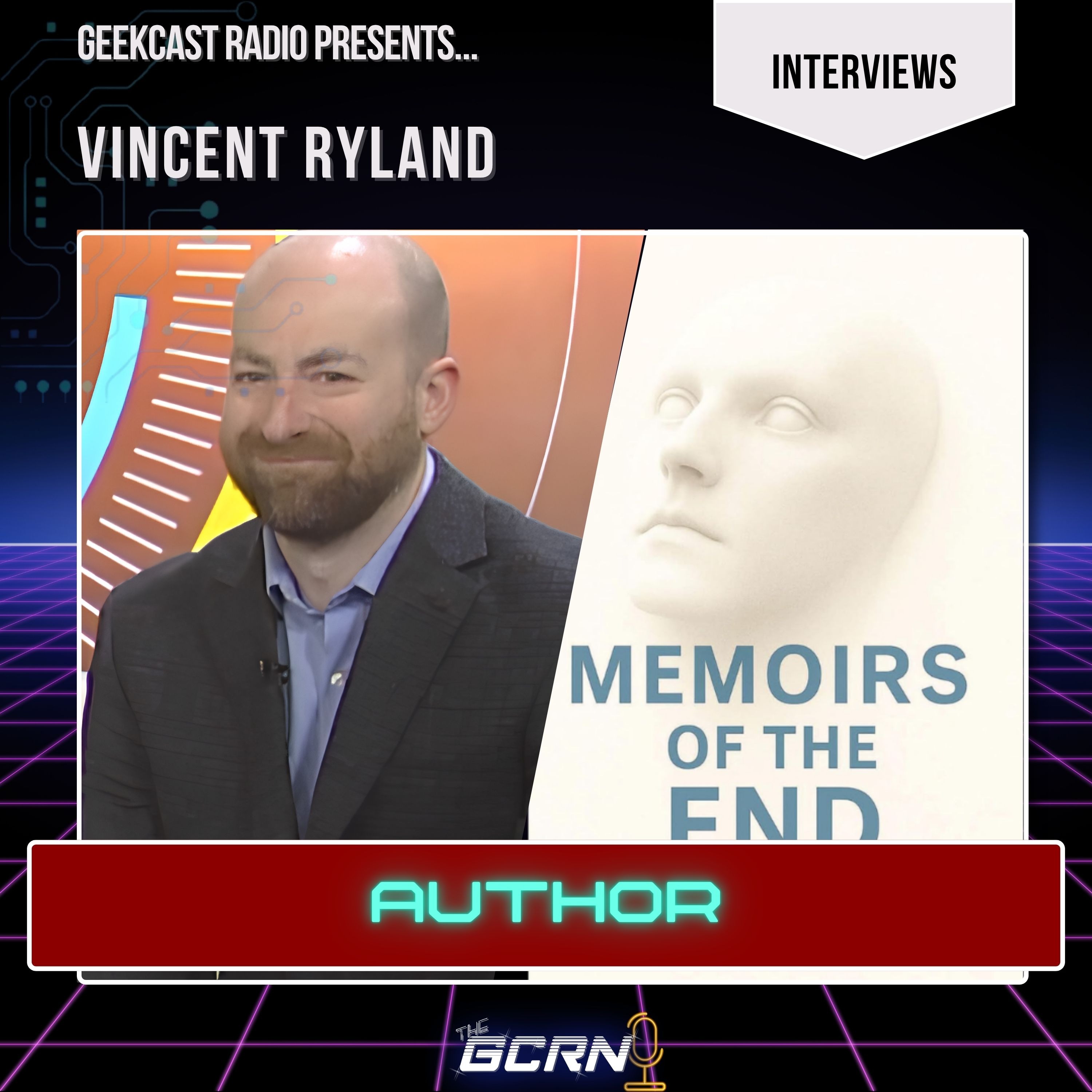
AI Dystopia, Corporate Mergers & "Memoirs of the End" with Author Vincent Ryland
Transformers 40th Anniversary Release, Darkwing Duck Casting, Toys R Us Comeback, Gremlins 3 Teaser & Studio Re-releases