 Altered Geek
Interview with Eric Schumacher on Acting, Directing, and Sci-Fi
About this Episode
Hey, this is Steve Bloom, and you are listening
to the Geekcast Radio Network. You are tuned
in to Steve Megatron on Altered Geek. Hello,
and welcome to Altered Geek. I'm your host, Steve
Megatron Phillips. Today, I'd like to welcome
to the program Eric Schumacher, film and TV actor,
producer, director, owner of Sealy Studios, and
proud geek. Welcome, Eric. Thank you, and I'm
very glad to be here. Thanks for having me, Stephen.
Yes, thank you for joining me. So, just for the
listener's purpose, could you tell the listeners
a little bit about yourself? Sure. Well, the
short story is I am a geek of many kinds. I'm
an acting geek. I'm a filmmaking geek. I'm a
geek geek. I was raised by a family of actors
and began my training, well, the earliest that
I remember was six years old, although my dad
insists it was earlier. And fell madly in love
with the art. And as I continued to pursue an
acting career, I eventually decided to start
studying the filmmaking side of things as well,
mainly so I could better understand how that
side worked to be a better actor. And I realized
I had some talents on that side as well. So I
started making commercials and movies and a variety
of other things. currently, I guess, best known
for I'm one of just a very handful of actors
I'm proud to say who have ever played both Doc
Holliday and Wyatt Earp in two separate nationally
publicized productions. And I am a big fan of
science fiction, fantasy, geek culture sort of
stuff that tends to be mainly the bulk of what
I end up producing and or directing his stuff
in that genre. And, of course, as you mentioned,
I'm the current president of the production group
Sealy Studios, which tends also to specialize
in some of those genres. Awesome, awesome. Yeah,
I was doing some research earlier, kind of checking
out some of the stuff that you guys have done.
The science fiction aspect always piques my interest
because I'm huge into sci -fi. I never would
have guessed that about you. Yeah, it's a sickness.
But yeah, Star Trek. Sci -fi, Star Wars, time
travel, any of that kind of stuff. You can't
see me giving you the Vulcan live long and prosper
symbol right now, but I'm doing it with both
hands. Skype has that as an emoji now, which
is funny. What are you talking about, Willis?
I didn't know that. That's awesome. Yeah, because
I almost did that earlier, and then I was like,
I don't know. Because it transports away. What
have been some of your, because I noticed that
Sealy Studios is promoting the My Stolen Time
Machine. Yeah, well, that's a project that is
in post -production right now. We had a bit of
a hitch. Unfortunately, my very wonderful business
partner, Don Demme, passed away just a couple
of months ago after a long battle with cancer.
And that was a project that he produced and I
directed. In fact, it was the catalyst to me
becoming a partner in the company. But we're
expecting that to finally launch about the middle
of this year. It's a science fiction short episode
series, currently about 26 episodes long. And
the gist of it is a... A teenage girl genius
steals her father's half -made time machine to
cheat on a history exam and accidentally almost
destroys the universe, making multiple versions
of herself throughout time and space, and now
she has to work with herself to fix it. Wow.
If it weren't for the fact I'm very into sci
-fi time travel aspect, that would sound very
confusing. I imagine your audience won't find
it confusing. No, not at all. Not at all. I've
given them the lowdown on a screenplay I wrote
similar to, well, not similar. It's past and
future, but it's superhero based in time travel.
So I wrote that in a college course. So that
was very convoluted. Very cool. Very cool. So
what are some inspirations for your various projects,
whether it's acting or writing and directing?
Well, you know, I think that's a difficult question
to answer. It really depends on the project.
But there are projects that I partner. or we,
I should say, partner with others on, and sometimes
they're brought to us and we partner in producing
them. Other times they're things that we generate
ourselves. I would say that since I'm now in
charge of things, the types of projects that
we initiate tend to be on... Typically, science
fiction, fantasy, what we look for in a project
that we want to sink our teeth into is a unique
angle, a unique twist, and a statement about
something that will hopefully generate conversation.
So, you know, for example, My Soul and Time Machine,
when Don and I created that series, the intention
was to, in fact, create... you know, kind of
a girl time traveler before Doctor Who did. And
we wanted to have a female -led show that was
very much, that had the side effect of exploring
a young woman as she finds out who she really
is. And so the fact that she has multiple selves
allows her to examine. um who she is as a person
and who she could be as a person if she if she
makes the right moves or the wrong moves examine
her own insecurities through a um you know a
a comedic script and uh so we're always looking
for things that uh have personal meaning to uh
to our audience and and things that uh we feel
deserve to be explored in in a unique way um
in terms of my work as an actor though it's you
know of course part of it is what I'm offered.
But especially since I'm now running the company,
I'm being very picky about what I take on because
I don't have a lot of extra time, so I really
have to make sure the projects that I agree to
as an actor are things that I believe have some
artistic worth or are particularly well -paying
or good for the career. Certainly the opportunity
to play Doc Holliday a couple of years ago, that
was one I wasn't going to pass up, especially
since it was directed by Alex Cox, who's a very
brilliant man. You may know him from Weepo Man
and Sid and Nancy and a bunch of really amazing
films like that. So likewise as an actor, though,
if I have my choice, if I have my druthers, I'm
looking for stuff that allows me, well, for one,
and also to go into a, I like going into a deep
character or a meaty character. I'm one of those
actors who tends to disappear into a role. When
I've gotten, I've been very honored that some
of my filmmaking friends have seen me in principal
roles and things and didn't realize it was me
until the credits. And that was about the nicest
thing that could ever have said to me. Those
are always the most amazing roles to me are the
ones that can blend in like a chameleon. Yeah,
yeah. And they're the most, for me, they're the
most gratifying to play typically because, you
know, it allows me to really kind of, it forces
me to take a completely different person's perspective
in life and find a way to play that truthfully,
which means that I, The side effect is that I
grow as a person because I'm not just playing
something that's so close to me that there's
not a lot of necessary emotional growth. Mind
you, that being said, the right thing that is
kind of close to me I'll take. We're finishing
final post -production after a... soft world
premiere of the feature film Revenge of Zoe,
which is incidentally set largely in a comic
book store and involves an imaginary superheroine
and screenwriting. It's a really funny comedy
co -produced with TV's Meteorite Men's Jeffrey
Notkin and Marty Campbell and Cliff Cattola of
Pondo Enterprises. And I played a character in
that that was actually... A lot like me maybe
20 years ago. And actually still fairly a lot
like me. My real personality tends to be the
type that's very driven and serious and uptight.
And this character was that to the nines. And
also an uber geek. Yeah, that's definitely...
and awesome getting to kind of feel it out and
be able to play yourself in a sense throughout
whatever role you're playing. What were some
of the characters that have inspired you when
you've gone into character, when you've gone
into your blending mode? That's a good question.
I rarely look at the work of others. when I'm
going into character, unless I have a very specific
reason to do that, I try to... So I kind of try
not to reference too much other people's work
at all, and instead just go into a process of
building a person from the ground up. But certainly,
I mean, you can't help but be influenced a bit
by other people's work or by other characters.
So, I mean, I think as I was a decent example
of that is when I was playing Wyatt Earp for
a television show called Legends and Lies, The
Real West for Fox. I do recall mentally referring
to some of the better kind of tough guy roles
that I'd seen played over the years. Um, you
know, a lot of, a lot of the scenes with Wyatt
were him intimidating somebody. And so I, uh,
I remember looking at the way that, uh, maybe
Sylvester Stallone had played a role or looking
at, you know, I didn't necessarily go and watch
the films. I just kind of remembered the scenes
and thought about, you know, how did they come
across as unflappable and very tough. Um, and
then the rest again was just a lot of character
research and trying to figure out who I thought
this person was and how they would, emerge through
me. That's awesome. Having looked at your list
of credits, it's made me want to go back and
watch some of the series or some of the films
that you've been in because reading the premise
of a lot of them just has me interested. Thank
you. like the the revenge of zoe like that has
me interested a little bit like i'm i love anytime
like comics or or just different things that
you just don't normally see kind of come out
anymore because it seems like everything is like
uh a continuation of a franchise at this point
very true uh yeah i know exactly what you're
talking about and that's actually as we're building
uh sealy studios and and moving our current plans
forward, that's a lot of our goals are to help
get very unique and unique good stories out there
that are not necessarily just a repaste, you
know, not cut, paste, repeat necessarily. You
know, we like the idea of creatively, I suppose
you could, to quote my Kung Fu grandmaster, having
wings of mind. And, but, you know, certainly
not in a way that's just a disorganized mess.
They still have to be projects that people can
understand and that are commercially viable.
But, you know, I'm only, again, looking for that
unique concept or, I mean, if there is really
anything unique anymore, but something that's
not just the standard. If we're doing a superhero
storyline, I don't want to do the standard superhero
storyline where Much as I love a lot of the more
recent superhero releases, about five minutes
in I can tell you the entire plot line and most
of the dialogue. Yeah, yeah, it's gotten pretty
formulaic. It has, and that can be satisfying.
I mean, that's the payoff that I want emotionally
if I'm going to see that particular kind of movie,
but there's a point where it's like, you know,
okay, I'm enjoying the visual ride and the performances
are good, but I have seen this movie. What are
some projects that you enjoy taking on? Do you
enjoy doing feature films or web series or I
saw in there, animation? We've done some animation.
The bulk of the animation that was done in the
past was under Don's leadership and I wasn't
directly involved with most of those, although
it's stuff we can do. But I do love animation
projects. And I should add, by the way, that
I'm also a voice actor. And one of my teachers,
some of your audience might remember, was a gal
who passed away recently, Lucille Bliss, who
was the original Smurfette on the NBC cartoon
show. Oh, wow. Yeah, she was awesome and kooky.
And so that was – she was – where I learned cartoon
voiceover. So I dig that stuff. I just haven't
had a lot of opportunity to do cartoon animation
as a producer. To answer your question, though,
yes. I like it all. When we're working on what
projects we're going to put onto our slate, To
me, I guess this is where the gut comes in. We
might be given a screenplay and it's like, this
is amazing. I've optioned a couple just recently
that are fantastic and they're perfect as films.
There are things that we start developing and
we look at them and I can kind of go, okay, yeah,
this smells like a series. I want more time to
tell this story. And I think that's what's going
to sell here. This feels like a feature film,
and that's how we're going to develop this. So
really it just kind of comes down to what is
the right media to tell that story, and that's
what I like. But I can tell you that I am particularly
fascinated by the concept of the web series,
which now is a television series, let's face
it. It's all blended. Oh, yeah. And I love the
idea, in principle, I love the idea of being
able to really spend a lot of time with characters.
I really, really get to know them over time.
I do really enjoy the feature film process, and
I really enjoy watching a feature film. But if
I had to choose between the two artistically,
then I would probably go with the series concept,
just because if I really love the characters,
I want to be with them for a while. Yeah, I can
totally relate to that. I mean, there's the potential
with film, but you're still kind of limited to
the amount of story you can tell with that block
of space as opposed to the web series or the
television series. There's just so much more
breadth that you can put into a series, and it
allows you to take your time a little bit more.
Awesome. So what are some projects that may not
be listed or that you can speak about that you
have coming up? That I can speak about. That's
a good one. Well, we are also working on doing
a final launch target for a narco -crime drama
short series called El Patron the Master, which
was co -produced with a number of great people
who shall become evident soon. And actually that
went through a film festival run recently and
won some awards. Revenge of Zoe, of course, I've
talked about. We are in the process of doing
a lot of audiobooks right now. And I'm working
on a program that I can say very little about,
I'm afraid, that is somewhat related in partnership
with my friend, author, and publisher, David
Lee Summers, who's a fantastic sci -fi, horror,
and steampunk author. And so we're creating some
really exciting programs that are designed to
help grow the work of authors. And I can't say
too much more about that. But I will say that
audio books are a part of that. And we're working
on a number of those right now. And this is really,
you know, I think overall, I was developing a
strategy with Don before he passed away. Ultimately
what it came down to was the concept of, you
know, we really believe that artists working
together in the right way, in ways that make
sense commercially and in ways that make sense
in terms of doing honor to each other, allows
everyone to win. So we were developing a strategy
which we're in the process of launching that
is designed to help a lot of artists have better
careers. and to also create a lot of really excellent
media for audiences. And that's why I have essentially
no life right now. I just work all the time.
It's a very difficult strategy to launch, but
we believe it can work very, very well. And I'm
quite excited about it. I look forward to seeing
how that turns out. I'm a fan of audiobooks,
especially because of commute times. It just
makes it easier to listen to something on the
go, no matter where you're at. So that's always
something that interests me. And then the voice
acting aspect, whether it's reading or it's voice
acting in the audiobooks, that always... That
piques my interest. But us on the network, we
really enjoy voice actors. So that's something
that resonates really well with us. Right. Well,
you know, a big key to, I mean, we're doing a
lot more than just audio books. We're doing a
lot of video work, et cetera. But a big key to
a good audio book, I mean, it's a performance.
Even if it's one actor reading, it's still an
actor ideally reading. If it's a fiction book
and if it's a non -fiction book, it's still a
performance. There's both a matter of technical
performance skill that needs to go into it and
there needs to be heart. And I think heart is
the major point. It's got to be a heartfelt performance
or it's not going to engage. It's not going to
resonate. That field is just too competitive
right now to do any less than your best. Exactly.
So how can the listeners get a hold of you and
find out more about you and Sealy Studios Online?
Well, I am all over the place. I'm on Facebook,
Twitter, Instagram, LinkedIn, etc. You can go
to my personal actor website at ericschumacherfilm
.com. Schumacher is S -C -H -U -M -A -C -H -E
-R, for those of you who aren't native German
speakers. And, of course, we have two other websites,
well, three really right now, seeliestudios .com.
That's S -E -E -L -I -E. That site, by the way,
is being completely rebuilt, so it's an older
site that you'll see right now, but it's going
to have a lot of exciting things on it very soon.
And also our website, pulpgamer .com, which is
largely targeted to the board game and role -playing
game, analog gaming world, which is where Don
came out of, actually. And, of course, to find
out more about the film Revenge of Zoe, there's
revengeofzoe .com. Zoe is Z -O -E. And that site
is nearly fully built as we're getting ready
to launch the film. But ericschumacherfilm .com
is a good sort of central place for people to
find me. And, of course, just look me up on social
media. And I'm not hard to find there. If folks
want to reach out to me directly, I tend to be
a little bit slow on getting back to people because
I get a lot of messages, but I do really try
hard to get back to everyone. And I'm always
happy to hear from folks who are fellow artists
or would -be fans or people who already know
my work or whatever. I like people. As do we.
So I thank you, Eric, for taking the time. out
of your busy schedule to hang out with us here
on Altered Geek. My pleasure. So until next time,
get Altered Geeky with the Altered Geek.
No chapter markers for this episode.
Hosts

More from Altered Geek
All Episodes →
Skydance Acquires Paramount, DCU Critiques, and Audible AI
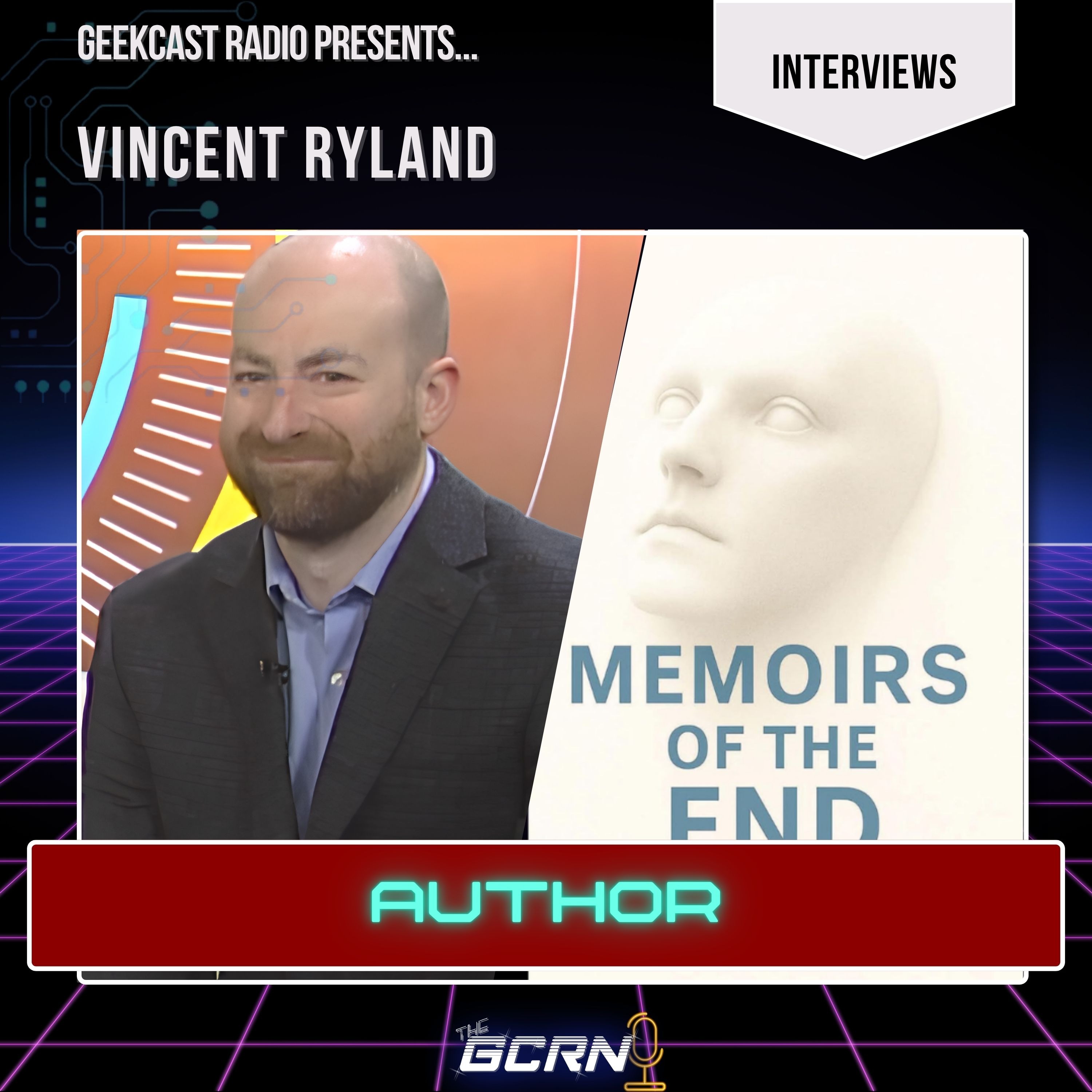
AI Dystopia, Corporate Mergers & "Memoirs of the End" with Author Vincent Ryland
Transformers 40th Anniversary Release, Darkwing Duck Casting, Toys R Us Comeback, Gremlins 3 Teaser & Studio Re-releases